Bait-lamina test
Ascoli D. 1
1 DISAFA, University of Turino
Last updated: 24/09/2026
Recommended citation:
Ascoli D. 2026. Bait-lamina test. In: Pere Casals, Davide Ascoli, Lena Vilà-Vilardell, Imma Oliveras, Madoka Krick (eds.) 2026. Methods handbook for characterizing fire use behavior, assessing fire effects, and monitoring soil and vegetation responses at the stand level. FIRE-ADAPT project (number 101086416), deliverable D1.1
Indicator
Ecosystem responses: Soil responses
Brief introduction
The bait-lamina test is a functional, in situ method for estimating the feeding activity of soil invertebrates involved in organic-matter breakdown. Thin, bait-filled PVC strips are inserted vertically in the soil. The proportion of bait consumed after a certain period (e.g. 30 days) provides an integrated measure of feeding activity and its vertical distribution.
The method is inexpensive, rapid to deploy at many sampling points and does not require taxonomic identification. It is therefore suitable for comparing burned and unburned plots and for repeated monitoring after wildfire or prescribed burning. Studies in Cerrado and Campos grasslands recorded a marked short-term decline in feeding activity after burning, followed by recovery over subsequent months as rainfall, vegetation and soil microclimate recovered (Musso et al., 2014; Berglund, 2020; Niva et al., 2021).
Bait consumption is strongly affected by season, soil moisture, temperature, vegetation and bait formulation. Consequently, fire effects should be assessed with a pre-fire baseline, concurrent unburned controls and identical exposure and scoring procedures. The test does not identify the organisms responsible and primarily reflects soil-fauna feeding rather than microbial activity alone.
Method specifications
Method type
Soft
Hard
Method timing
Before
fire
During
fire
After fire
(short-term)
After fire
(mid-term)
After fire
(long-term)
Field skills
Low
Medium
Hard
Lab skills
Low
Medium
Hard
Material cost
Low
Medium
Hard
Time cost
Low
Medium
Hard
Calculation expertise
Low
Medium
Hard
Equipment
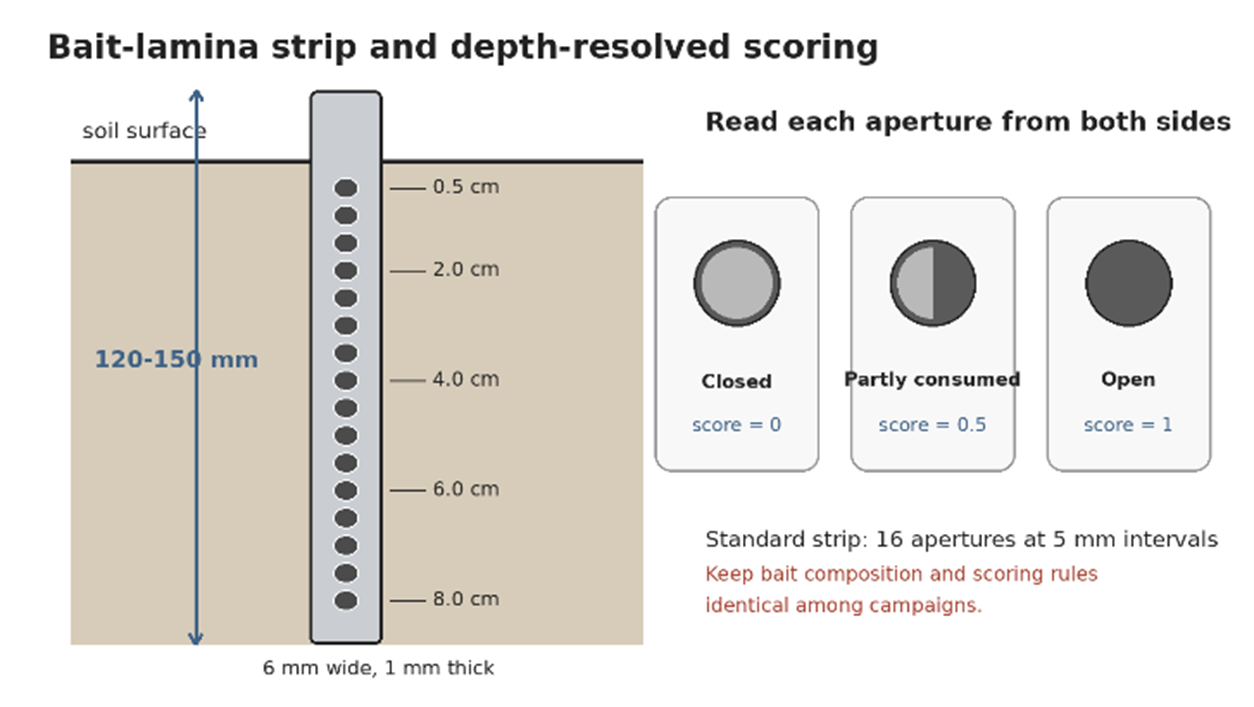
- Bait-lamina PVC strips (commonly used: 120 -150 mm long/ 6 mm wide/ 1 mm thick) with 16 biconical apertures
- Labels and permanent marker.
- Standard bait substrate: microcrystalline cellulose (70%), oat flour (27%), activated charcoal (3%) and deionized water; alternatively, commercially prepared strips.
- Narrow knife or stainless-steel spatula shaped like the strip; rubber mallet for compact soils.
- Nitrile gloves, field stakes/flagging, measuring tape and protective cages where trampling is possible.
- Aluminium foil, labelled plastic bags and a cool box for retrieval and transport.
Experimental design
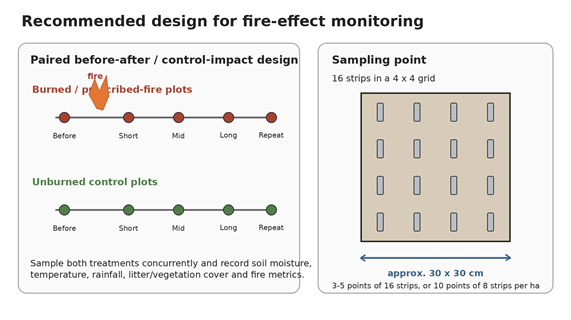
Use a paired before-after/control-impact design whenever possible.
Establish at least three replicate burned plots and three comparable unburned control plots.
Measure a baseline before ignition and repeat sampling concurrently in both treatments at short-, mid- and long-term intervals; published fire studies used campaigns from 3 days or 1 month to 6-7 months and about 12 months after burning.
Within each plot, distribute 48-80 strips per hectare, preferably as 3-5 sets of 16 strips or 10 sets of 8 strips. A set of 16 strips can be arranged in a 4 x 4 grid over about 30 x 30 cm, with strips approximately 3 cm apart; sampling points should be separated by about 10-15 m when plot size permits.
Use fixed stations (a station is a position in which you insert the bait lamina) but install each campaign at an adjacent, previously undisturbed position.
Record soil moisture, soil temperature, rainfall, litter/vegetation cover and relevant fire-behaviour or severity metrics.
Methodology
- Prepare and label the strips. Mix the dry bait components, add deionized water until a mouldable paste forms. Fill both sides of each aperture, air-dry for 12-24 h, refill shrinkage gaps and allow at least 72 h final drying. Keep the same bait formulation for all treatments and dates.
- At each sampling point, temporarily remove excess litter to expose the mineral-soil surface. Pre-cut a narrow vertical slit with a knife or metal spatula of similar dimensions. Avoid widening or disturbing the slit.
- Insert each strip carefully, perpendicular to the surface, with both faces in contact with soil and the first aperture approximately 0.5 cm below the surface. Replace the litter and mark or protect the point.
- Install 5-10 extra pilot strips in the reference/control area. Retrieve them at regular intervals to determine exposure time. Aim for about 50% consumption; the test is informative when at least one depth reaches about 30%, whereas consumption above 90% reduces sensitivity. Exposure commonly ranges from 10 to 28 days, but may be shorter or longer depending on climate and soil.
- Retrieve strips gently, without knocking them together. Wrap each strip separately in aluminium foil, place sets in labelled bags, keep cool and transport to the laboratory. Refrigerate temporarily if immediate reading is not possible.
- Clean both faces carefully with damp tissue or a soft brush. Examine every aperture from both sides against a light source. Score using either a binary rule (consumed >50% = 1; not consumed = 0) or a three-level rule (open >70% = 1; partial 31-69% = 0.5; closed <30% = 0). Use one rule consistently and, where possible, one trained reader.
- Record scores by strip and aperture depth, together with lost or damaged strips and environmental covariates. Do not treat missing strips as zero consumption.
- Strip dimensions and bait recipes vary among studies. Comparisons are valid only when dimensions, bait composition, exposure time and scoring criteria are standardized or explicitly accounted for.
- Seasonality can be stronger than the fire effect. Burned and control plots should always be sampled at the same time and interpreted with moisture and temperature data.
- Hard or stony soils may prevent good soil-strip contact and can damage apertures. Pre-cut the slit and reject positions where roots, stones or an oversized gap prevent close contact.
- Horizontal surface placement is a published variant for surface detritivory, but it should be analysed separately from the standard vertical soil profile.
Calculations
Let sᵢⱼ be the score for aperture i on strip j (1, 0.5 or 0), and n the number of valid strips in the sampling point.
\mathrm{Overall\ Feeding\ Activity}(\%)= \frac{100\sum_i\sum_j s_{ij}}{16n}
where dᵢ is the depth of aperture i. Calculate each sampling-point value first and use sampling points or plots – not individual apertures – as independent replicates. If exposure durations differ, report activity per exposure period and standardize only when the assumption of approximately linear consumption is justified. For fire monitoring, test treatment x time and treatment x time x depth effects with a repeated-measures or mixed-effects model that respects the block/plot structure.
Relation with other methods
Combine bait-lamina data with soil moisture and temperature, rainfall, litter depth/consumption, vegetation recovery and fire severity or soil-heating measurements. Litter-bag assays provide a complementary measure of mass loss, while soil-fauna extraction can identify changes in abundance or community composition. Because bait disappearance does not identify taxa and is not a direct microbial assay, microbial biomass, respiration or enzyme measurements are useful where the objective is to separate faunal and microbial responses.
Illustrations
Data templates
NA
Further information
Berglund, H. 2020. Biological Soil Invertebrate Activity in a Tropical Rainforest: A comparison of soil invertebrate activity in two tropical rain forests in Borneo. Uppsala University.
International Organization for Standardization. 2016. ISO 18311: Soil quality – Method for testing effects of soil contaminants on the feeding activity of soil dwelling organisms – Bait-lamina test. Geneva.
Kratz, W. 1998. The bait-lamina test: General aspects, applications and perspectives. Environmental Science and Pollution Research 5: 94-96.
Musso, C., Miranda, H.S., Soares, A.M.V.M., Loureiro, S. 2014. Biological activity in Cerrado soils: evaluation of vegetation, fire and seasonality effects using the bait-lamina test. Plant and Soil 383: 49-58.
Niva, C.C., Pulrolnik, K., Marchão, R.L., Carvalho, A., Machado, C.T.T., Pereira, C.D., Malaquias, J.V., Vilela, L., Römbke, J. 2021. Método bait-lamina para a avaliação da atividade alimentar de invertebrados edáficos: eficiência, limitações e adaptações para seu uso. Embrapa Cerrados, Documentos 392.
Podgaiski, L.R., da Silva Goldas, C., Ferrando, C.P.R., Silveira, F.S., Joner, F., Overbeck, G.E., Mendonca Jr, M.S., Pillar, V.D. 2014. Burning effects on detritivory and litter decay in Campos grasslands. Austral Ecology 39: 686-695.
Rożen, A., Sobczyk, Ł., Liszka, K., Weiner, J. 2010. Soil faunal activity as measured by the bait-lamina test in monocultures of 14 tree species in the Siemianice common-garden experiment, Poland. Applied Soil Ecology 45: 160-167.