Skip to content

Digital photos and relevant dimension measurements for fuel volume estimation

Bacciu, V.1, Pellizzaro, G.1, Scarpa, C.1

1National Research Council of Italy – Institute for the BioEconomy

Last updated: 25/09/2026

Recommended citation:

Bacciu, V., Pellizzaro, G. & Scarpa, C. 2026. Digital photos and relevant dimension measurements for fuel volume estimation. In: Pere Casals, Davide Ascoli, Lena Vilà-Vilardell, Imma Oliveras, Madoka Krick (eds.) 2026. Methods handbook for characterizing fire use behavior, assessing fire effects, and monitoring soil and vegetation responses at the stand level. FIRE-ADAPT project (number 101086416), deliverable D1.1

Indicator

Fuel load: Surface fuel loading

Brief introduction

Volume refers to the amount of fuel available for combustion. The greater the volume of fuel available, the more intensely a fire will burn. Sirca et al (2016) explored the potential application of two expeditious and non-disruptive methodologies that linked apparent volume (AV) with aboveground biomass estimation. The approach has been applied for three of the most representative maquis species of the Mediterranean basin (Pistacia lentiscus L., Cistus monspeliensis L. and Euphorbia dendroides L.) but it can be used and adjusted also for other species. The first methodology assumed the shrub shape (or canopy) to be similar to a regular tridimensional solid, while the second method was based on plant digital images analysis.

Method specifications

Method type

Soft

Hard

Method timing

Before
fire

During
fire

After fire 
(short-term)

After fire
(mid-term)

After fire
(long-term)

Field skills

Low

Medium

Hard

Lab skills

Low

Medium

Hard

Material cost

Low

Medium

Hard

Time cost

Low

Medium

Hard

Calculation expertise

Low

Medium

Hard
Equipment

  • Digital camera

  • A measuring tape of ca. 2 m

  • Microsoft Power Point and Excel software or equivalent

Experimental design

Once the study area has been selected, preliminary measurements of plant height and crown diameter should be randomly collected to characterize the structural variability of the plant community. Subsequently, shrubs representing a range of sizes should be randomly sampled (>10 individuals) from the most abundant species in the study area. Aboveground volume (AV) should then be estimated for each sampled shrub using the two methodologies described below.

Methodology

Methodology 1

Aboveground volume (AV) should be estimated by approximating shrub shape to regular three-dimensional solids. Plant height (H), maximum crown diameter (MD), and crown diameter measured orthogonally to MD (OMD) should be used to calculate the volume of six geometric solids: circular cylinder, elliptical cylinder, sphere, paraboloid, ellipsoid, and half ellipsoid. The corresponding volume equations are reported below in the Calculations section.

Methodology 2

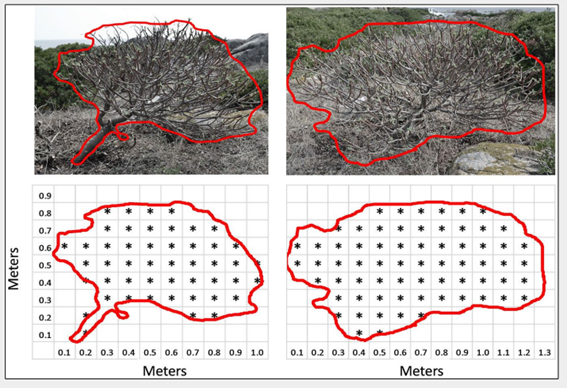
The AV should be estimated using a methodology adapted from Montès et al. (2000). The methodology includes the following steps (Fig. 1):

  1. A digital camera was used to take two orthogonal view pictures in correspondence of plant MD and OMD sides;
  2. The software Microsoft Power Point® was used to manually digitize the plant contour displayed in the pictures;
  3. A worksheet (Microsoft Excel®), with cells previously organized in a grid of 0.1 × 0.1 m, was used to place the plant digital contour on the grid, and to calculate the apparent volume for each shrub layer. The AV of each shrub was obtained through the sum of each layer’s volume.

Calculations

Geometric model:

  1. Circular cilinder

\mathrm{AV}(\mathrm{m}^{2})= \frac{\pi}{4}\times \text{MD}^{2} \times {H}

\begin{array}{l} \textbf{Where:} \\[0.5em] \mathrm{AV} = \text{Shrub aboveground volume} \\ H = \text{Plant height} \\ MD = \text{Maximum crown diameter} \end{array}

2. Elliptical cilinder

\mathrm{AV}(\mathrm{m}^{2})= \frac{\pi}{4}\times \text{MD} \times{OMD} \times {H}

\begin{array}{l} \textbf{Where:} \\[0.5em] \mathrm{AV} = \text{Shrub aboveground volume} \\ H = \text{Plant height} \\ MD = \text{Maximum crown diameter} \\ OMD = \text{Crown diameter measured orthogonally to MD} \end{array}

3. Sphere

\mathrm{AV}(\mathrm{m}^{2})= \frac{\pi}{6}\times \text{MD}^{3}

\begin{array}{l} \textbf{Where:} \\[0.5em] \mathrm{AV} = \text{Shrub aboveground volume} \\ MD = \text{Maximum crown diameter}  \end{array}

4. Paraboloid

\mathrm{AV}(\mathrm{m}^{2})= \frac{\pi}{8}\times \text{MD} \times{OMD} \times {H}

\begin{array}{l} \textbf{Where:} \\[0.5em] \mathrm{AV} = \text{Shrub aboveground volume} \\ H = \text{Plant height} \\ MD = \text{Maximum crown diameter} \\ OMD = \text{Crown diameter measured orthogonally to MD} \end{array}

5. Ellipsoid

\mathrm{AV}(\mathrm{m}^{2})= \frac{\pi}{6}\times \text{MD} \times{OMD} \times {H}

\begin{array}{l} \textbf{Where:} \\[0.5em] \mathrm{AV} = \text{Shrub aboveground volume} \\ H = \text{Plant height} \\ MD = \text{Maximum crown diameter} \\ OMD = \text{Crown diameter measured orthogonally to MD} \end{array}

Relation with other methods

NA

Illustrations

Fig. 1. The apparent volume estimation with Methodology 2: digital photos and contouring (upper panels); a view of Excel worksheet for the volume calculation (lower panels). The apparent volume of the shrub is obtained summing the volume of each layer of 0.1 m height. Source: Sirca et al. (2016)

Data templates

NA

Further information

Sirca C, Caddeo A, Spano D, Bacciu V, Marras S (2016). Methods for biomass stock estimation in Mediterranean maquis systems. iForest 10: 108-114. – doi: 10.3832/ifor1769-009 [online 2016-08-21]

Montès N, Gauquelin T, Badri W, Bertaudiere V, Zaoui El H (2000). A nondestructive method for estimating aboveground forest biomass in threatened woodlands. Forest Ecology and Management 130: 37-46. – doi: 10.1016/S0378-1127(99)00188-7