Skip to content

Line intersect method to estimate downed woody fuel

Vilà-Vilardell, L.1; Casals P.1

1Forest Science and Technology Centre of Catalonia (CTFC)

Last updated: 25/09/2026

Recommended citation:

Vilà-Vilardell, L. & Casals P. 2026. Line intersect method to estimate downed woody fuel. In: Pere Casals, Davide Ascoli, Lena Vilà-Vilardell, Imma Oliveras, Madoka Krick (eds.) 2026. Methods handbook for characterizing fire use behavior, assessing fire effects, and monitoring soil and vegetation responses at the stand level. FIRE-ADAPT project (number 101086416), deliverable D1.1

Indicator

Fuel load: Ground fuel load

Brief introduction

This method estimates dead woody fine fuel loading (kg m-2), defined as the dry weight of fuel per unit area, by tallying the number of intersections of woody particles crossing a vertical sampling plane. Fuel loading is quantified separately for different fuel classes based on particle diameter: 1-h fuels: 0-6 mm diameter; 10-h fuels: 6-25 mm diameter; 100-h: 2.5-7.5 cm diameter. This classification is important because particle size influences how fuels respond to changes in atmospheric moisture. Specifically, it is based on the time-lag concept, which describes the time required for a fuel particle to reach equilibrium with ⅔ of the environmental moisture. 

Fuel loading by size class is a key component of fire behavior assessments, as it influences potential fire spread and fire intensity. It can also be used to estimate fire effects and is related to both vertical and horizontal fuel continuity.

This method is based on Brown (1974). Although coarser woody fuel loading (> 7.5 cm diameter) can also be estimated using this approach, it requires a slightly different sampling procedure. In this method, coarse fuels have been excluded because their contribution to fire spread and intensity is relatively small. For further information, see Woodall & Williams (2005).

Method specifications

Method type

Soft

Hard

Method timing

Before
fire

During
fire

After fire 
(short-term)

After fire
(mid-term)

After fire
(long-term)

Field skills

Low

Medium

Hard

Lab skills

Low

Medium

Hard

Material cost

Low

Medium

Hard

Time cost

Low

Medium

Hard

Calculation expertise

Low

Medium

Hard

Equipment

  • At least 3 measuring tapes of 25 m

  • A measuring tape of ca. 2 m

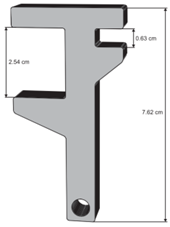
  • A go/no-go gauge (Figure 3)

Experimental design

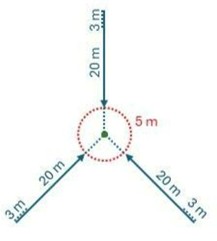
Locate the center of the plot and establish 3 to 5 sampling transects, depending on the density of fine fuel particles, each 25 m long. The transects are arranged radially from the center of the plot, maintaining equal angles between adjacent transects (Figure 1). The first transect should be aligned with the line of maximum slope. The tally begins at the outer end of each transect and proceeds towards the center of the plot, stopping 5 m from the plot center to avoid overrepresenting the central area.

Methodology

  1. Pull out the three 25-m transects as described in the Experimental design.
  2. Begin at the outer edge of the transect line and move toward the plot center, counting the number of wood particles intersecting the sampling plane by each size class (1-h, 10-h, 100-h). The diameter at the point the particle intersects the sampling plane determines the size class.
  3. Repeat the same procedure for each transect.
  4. Record the slope of each transect.
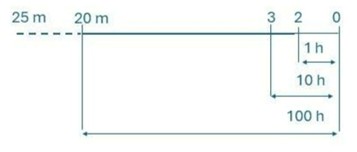
  5. The length of the transect can be adjusted to particle density. Suggested transect lengths are (Figure 2):
  • 1-h fuels: 2 m
  • 10-h fuels: 3 m
  • 100-h: 20 m

Calculations

\bar{y}(\mathbf{w})\,(\mathrm{Mg\,ha^{-1}}) = \frac{Gkac}{L}\sum_{i=1}^{n} d_i^2

\begin{array}{l} \textbf{Where:} \\[0.5em] \bar{y}(\mathbf{w})\,(\mathrm{Mg\,ha^{-1}}) = \text{Dry weight per unit area (Fuel load)} \\ G = \text{Specific gravity of the fuel type} \\ k = \text{Constant that accounts for unit conversions}^{1} \\ a = \text{Nonhorizontal lean angle correction factor}^{2} \\ c = \text{Slope correction factor} \\ L = \text{Total length of the transect}^{3} \\ d_i = \text{Diameter of the fine fuel piece at the point of intersection}^{4} \\ n = \text{Number of pieces intersected by the transect} \end{array}
c = \sqrt{1 + \left(\frac{\%\text{slope}}{100}\right)^2}
\begin{array}{l} \textbf{Where:} \\[0.5em] \mathrm{c} = \text{Slope correction factor} \\ \% \, \text{slope} = \text{Slope percent} \end{array}

1 k = 1.234 given that d (cm) and L (m) (Table 3.1 from Woodall & Williams, 2005).

2 a = 1 assuming no lean angle (Eq. 3.1a from Woodall and Williams, 2005)

3 Total length of the transect for each fuel size class. That is, if 1-h fuels are tallied along a 2-meter transect, then the transect length for that class is 2 meters.

4 The diameter of each individual fine fuel particle is not usually recorded. Thus, the sum of indidual particle diameters is replaced by the number of fuel particles in size-class s times the squared mean diameter for pieces within a fine fuel diameter class: 

n_s \times \bar{d}^{2}_s
\begin{array}{l} \textbf{Where:} \\[0.5em] \mathrm{n_s} = \text{Number of pieces of fine fuels in size class s} \\ \bar{d}^{2}_s = \text{Squared mean diameter for pieces within a fine fuel diameter class} \end{array}

Relation with other methods

See method Surface fuel-bed depth estimation through understory belt transects for additional measurement along the same transect design.

Illustrations

Figure 1. Layout of three 25-m-long transects arranged radially around the plot center.
Figure 2. Suggested transect length for each fuel size class.
Figure 3. A go/no-go gauge to determine the size class of fine fuels. From Prichard et al., 2019.

Data templates

NA

Further information

Brown, J. K. (1974). Handbook for inventorying downed woody material. Gen. Tech. Rep. INT-16. Ogden, UT: US Department of Agriculture, Forest Service, Intermountain Forest and Range Experiment Station. 24 p., 16.

Prichard, S. J., Andreu, A. G., Ottmar, R. D., & Eberhardt, E. (2019). Fuel Characteristic Classification System (FCCS) field sampling and fuelbed development guide. Gen. Tech. Rep. PNW-GTR-972. Portland, OR: US Department of Agriculture, Forest Service, Pacific Northwest Research Station. 77 p., 972.

Woodall, C. W., & Williams, M. S. (2005). Sampling protocol, estimation, and analysis procedures for the down woody materials indicator of the FIA program. Gen. Tech. Rep. NC-256. St. Paul, MN: U.S. Department of Agriculture, Forest Service, North Central Research Station. 47 p.