Diameter of smallest remaining charred twig
Casals, P. 1; Valor, T.2
1 Forest Sciences and Technology Centre of Catalonia
2 Department of Agri-Food Engineering and Biotechnology, Universitat Politècnica de Catalunya-BarcelonaTech, Castelldefels, Spain
Last updated: 28/09/2026
Casals, P. & Valor, T. 2026. Diameter of smallest remaining charred twig . In: Pere Casals, Davide Ascoli, Lena Vilà-Vilardell, Imma Oliveras, Madoka Krick (eds.) 2026. Methods handbook for characterizing fire use behavior, assessing fire effects, and monitoring soil and vegetation responses at the stand level. FIRE-ADAPT project (number 101086416), deliverable D1.1
Indicator
Fire Severity: Severity on vegetation
Brief introduction
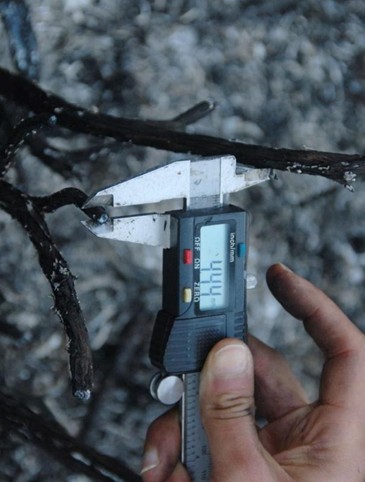
This method is designed to estimate the fire severity in shrub fuel complexes following prescribed burning or wildfires. Fire severity is estimated based on the diameter of the smallest twig remaining on the shrub-like woody skeleton (Fig. 1): For homogeneous fuel-beds, large shrub skeletons that retain small twigs can be considered to have experienced a relatively low-severity fire, and conversely, skeletons where small twigs were fully consumed, leaving only large twigs, experienced high severity fire (Allen et al. 2026). Under uniform burning conditions, larger minimum branch diameters may indicate longer residence time and greater heat release (Moreno and Oechel, 1989; Allen et al. 2026).
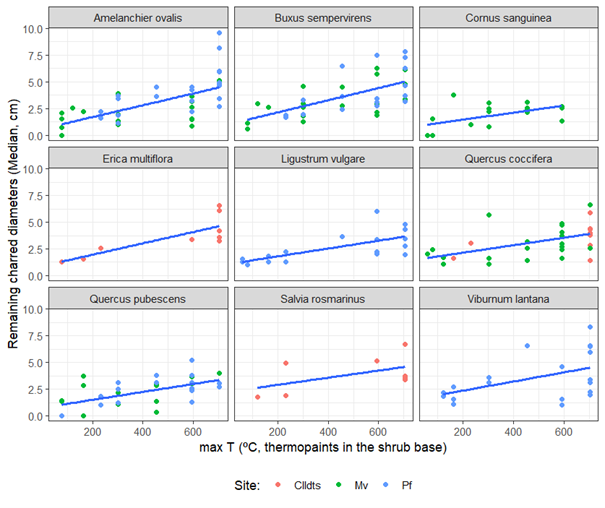
The charred twig diameter aligns with other indicators of fire intensity (e.g., maximum fire temperature -Fig. 2-, combustion duration) or fire severity (e.g., water evaporation from cans during fire, depth of litter consumed). The average charred twig diameter has been used as a complement or improvement on fire severity assessments that use space-borne or aerial remote sensing data (e.g. Belikov et al. 2023). The method can also contribute to understanding ecosystem responses (e.g. seedling recruitment, resprouting vigor).
The method varies by measurement location relative to the tip (i.e., at the tip versus one centimeter from tip) and twig selection (e.g., by selecting the smallest twigs, haphazardly selecting a subset of outer branches, or thorough sampling of outer branches). Allen and coworkers (2026) recommend measuring at the tip rather than measuring one centimeter from the tip. Since wood density impacts stem loss during fire, the measurements obtained reflect the degree of consumption of the woody individuals of the same species.
The main advantages of this method is its simplicity, cheapness and the potential to assess the spatial variability of fire severity, even several months after fire (Moreno and Oechel, 1989). The method will allow between-burn and within-burn fire-intensity comparisons across shrub-fuel complexes.
Method specifications
Method type
Soft
Hard
Method timing
Before
fire
During
fire
After fire
(short-term)
After fire
(mid-term)
After fire
(long-term)
Field skills
Low
Medium
Hard
Lab skills
Low
Medium
Hard
Material cost
Low
Medium
Hard
Time cost
Low
Medium
Hard
Calculation expertise
Low
Medium
Hard
Equipment
- Electronic vernier caliper for measuring twig diameter
- Field notebook or electronic device for recording data
Experimental design
Establish a randomly located plot1 within representative units. In each plot, identify the main woody species2 and select a minimum of 10 individuals per species. If the objective is to compare the severity between units, the individuals should be representative of the degree of consumption observed in the plot, avoiding individuals unaffected by the fire or heavily consumed; while, if the objective is to quantify the severity between species, the number of individuals must be higher (~30 individuals) and selected randomly in the plot or systematically in a transect across the plot.
It is advisable to take measurements in the first few days after the fire although it is possible to record data several months or years after (Moreno and Oechel 19898; Allen et al. 2026), since burned skeletons are very resistant to wind or rain. When sampling is delayed post-fire if a lot of weathering has occurred, it might be better to measure one cm from the tip (Allen et al. 2026).
1 Plot size depends on the area burned and the density of understory woody plants. 30 m x 30 m is enough for a Mediterranean shrubland fire complex.
2The severity for a similar intensity may depend on the species
Methodology
- Before the burn or after a wildfire, establish a representative sampling unit (plot or transect with at least 10 individuals of the target woody species).
- Identify the dominant plant species from scorched leaves, bark details or resprouts.
- Select the individuals to be measured for each species. Optionally geoposition each individual in the plot
- Measure the diameter at the tip of the smallest-diameter twig that is at least 1 cm long on each remaining stem of the plant using an electronic caliper (Fig. 1). Measure up to five stems per individual, where possible3. Stems are considered separate if they split within six cm aboveground.The height of the branches measured can vary depending on the degree of burning.
- Record all the measurements for each individual.
3 In case of a low number of stems, the variability between individuals may be greater
Calculations
It is recommended to calculate the median4 diameter for each individual, and the mean and standard deviation for each species. The coefficient of variation between individuals allows for comparison of the variation in severity among individuals of different species and can provide an estimate of the variability in severity within the unit.
4 The median allows correcting for the error of having measured a very large diameter (e.g., of a dry branch) or a very small one (a branch that is not very burned).
Relation with other methods
NA
Illustrations
Data templates
NA
Further information
Allen, J., Benterou, D., Brillon, H. et al. 2026. Reexamining the relationship between post-fire twig diameter and fire intensity in California’s chaparral to better assess fire severity. Fire ecol. https://doi.org/10.1186/s42408-026-00486-4
Belikov, N., Bueno-Kling, A., Haddad M. 2023. Chaparral resurgence: Assessing the effects of fire intensity on post-fire regrowth. CEC Research, 7(3) https://doi.org/10.21973/N3D09F.
Casals P, Valor T, Rios A I, Shipley B. 2018. Leaf and bark functional traits predict resprouting strategies of understory woody species after prescribed fires. For. Ecol. Manage. 429, 158-174.
Keeley, J.E., Brennan, T., Pfaff, A.H. 2008. Fire severity and ecosystem responses following crown fires in California shrublands. Ecol Appl 18:1530–1546. https://doi.org/10.1890/07-0836.1
Moreno, J. M., and Oechel W. C. 1989. A simple method for estimating fire intensity after a burn in California chaparral. Acta Oecologica 10:57–68.