Fuel volume and load of shrub-like woody plants in a belt transect
Casals P.1 ; Vilà-Vilardell, L.1;
1Forest Science and Technology Centre of Catalonia (CTFC)
Last updated: 24/09/2026
Recommended citation:
Casals P, Vilà-Vilardell, L. 2026. Fuel volume and load of shrub-like woody plants in a belt transect. In: Pere Casals, Davide Ascoli, Lena Vilà-Vilardell, Imma Oliveras, Madoka Krick (eds.) 2026. Methods handbook for characterizing fire use behavior, assessing fire effects, and monitoring soil and vegetation responses at the stand level. FIRE-ADAPT project (number 101086416), deliverable D1.1
Indicator
Fuel flammability: Fuel structure
Fuel load: Surface fuel loading
Brief introduction
Method specifications
Method type
Soft
Hard
Method timing
Before
fire
During
fire
After fire
(short-term)
After fire
(mid-term)
After fire
(long-term)
Field skills
Low
Medium
Hard
Lab skills
Low
Medium
Hard
Material cost
Low
Medium
Hard
Time cost
Low
Medium
Hard
Calculation expertise
Low
Medium
Hard
Equipment
- Measuring tape of 10 m
- Compass
- Clinometer
- Metallic bars or wooden poles to delineate the boundaries of the sampling subplots
- Wooden or metallic stakes to relocate the transect for subsequent measurements
- Measuring tape of ca. 2 m for plant dimensions
Experimental design
The cover and height of shrub individuals are estimated in a fixed-area plot or fixed belt transect. The sample unit can be placed randomly or systematically within the study area1. The size of the sample unit depends on the cover and height of understory woody plants, and can be adjusted after fire as the spatial variability generally increases2. Plant dimensions (e.g., apparent volume) are converted into fuel load using available allometries of the most important species in the stand3. As allometries are in general site and species-specific, it is necessary to obtain allometric regressions of the morost important shrub-like species in the region.
The development of allometric regressions is beyond the scope of this sheet, but can be addressed from specific bibliography, see for instance the references in De Cáceres et al. (2019).
1 Systematically placed is recommended for repeated measurements before and after fire in order to better estimate changes in fuel volume post-fire.
2 Two belt transects of 10 m x 1 m can be enough for dense shrublands or understory dominated by individuals with a crown cover < 1 m2. After burning, the size must be increased to better gather the variability, for instance, a belt transect of 50 m x 2 m,
3 When allometries are not available for a specific plant species, one can use allometries calibrated for morphologically or functionally similar species groups.
Methodology
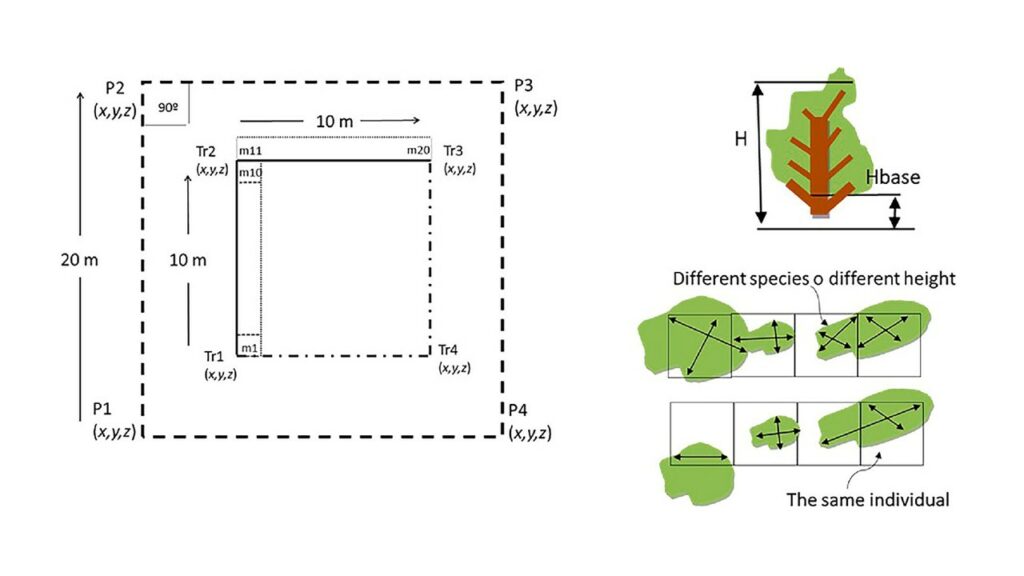
- Set the belt transect in a representative location of the stand and pull out two 10-m transects forming an L shape (Figure 1). The first transect should be aligned with the line of maximum slope in steep areas and towards the North in flat areas. The second transect should be established at 90º of the first transect. The 1-m belt transect is arranged in the inner part of the plot in the first transect and in the external part in the second transect.
- Record the date, plot reference and GPS datum, precision, and coordinates. Annotate the slope and orientation of each transect.
- Start at the beginning of the first transect and move at 1 m. For each 1 m2 subplot inventoried, record all shrub individuals taller than 0.3 m that have the crown within the belt transect, and annotate the following information:
- Species name
- Crown longest and normal diameters (D1, D2 in cm, precision ± 5 cm) within the 1 m2 subplot.
- Crown height (H, in cm, precision ± 5 cm)
- Distance from the crown base to ground (Hbc, in cm, precision ± 10 cm). We define crown base as the height at which most of the leaves and fine branches become dominant.
- Additionally, for each 1 m2 subplot in each transect, estimate visually:
- the percent cover and average height of the herb stratum (Hc in %).
- the surface cover and average thickness of litter.
Calculations
Before proceeding with the calculations, convert all measurements in cm to m.
Apparent volume of each shrub-like plant individuals (Svi, m³ m⁻²) is calculated assuming the shape of a solid body such as an elliptic cylinder or a rectangular prims for each plant individual.
Fuel load of shrub-like plants (Sw, kg m⁻²) is usually calculated using power functions to model total or fine fuel weight (Sw) from the apparent volume of each individual (Sv), and where a and b are species-specific or group-specific regression parameters (De Cáceres et al., 2019)4:
Fuel load of herb stratum (Hw, kg m⁻²) can be calculated from cover and height similarly to shrub-like plants and when a1 is a species or group-specific regression parameter:
4 Systematically placed is recommended for repeated measurements before and after fire in order to better estimate changes in fuel volume post-fire.
5 Two belt transects of 10 m x 1 m can be enough for dense shrublands or understory dominated by individuals with a crown cover < 1 m2. After burning, the size must be increased to better gather the variability, for instance, a belt transect of 50 m x 2 m,
3 When allometries are not available for a specific plant species, one can use allometries calibrated for morphologically or functionally similar species groups.
Relation with other methods
See destructive methods to estimate fuel load
Illustrations
Further information
Bonham Ch. D. 2013. Measurements for terrestrial vegetation. John Wiley & Sons, 2º Ed. Oxford. UK. 246pp.
Casals P, Gabriel E, De Cáceres M, Ríos A.I., & Castro X. (2023). Composition and structure of Mediterranean shrublands for fuel characterization. Ann. For. Sci. 80, 23.
De Cáceres M, Casals P, Gabriel E, & Castro F. (2019). Scaling-up individual-level allometric equations to predict stand-level fuel loading in Mediterranean shrublands. Annals of Forest Science, 76:87.
Étienne M., & Rigolot E. (2001). Méthodes de suivi des coupures de combustible. Réseau Coupures de combustible. Éditions de la Cardère. Morières
Fernandes P.M., Loureiro C., & Botelho H. (2012) PiroPinus: a spreadsheet application to guide prescribed burning operations in maritime pine forest. Comput Electron Agric 81:58–61.
Montero, G., Pasalodos-tato, M., López-Senespleda, E., & Madrigal, G., (2013). Ecuaciones para la estimación de la biomasa en matorrales y arbustedos mediterráneos, in: 6 Congreso Forestal Español.
It is possible to add links