Coring tree for assessing tree growth changes
Valor T. 1
1 Department of Agri-Food Engineering and Biotechnology, Universitat Politècnica de Catalunya-BarcelonaTech
Last updated: 09/09/2026
Recommended citation:
Valor T. 2026. Coring tree for assessing tree growth changes . In: Pere Casals, Davide Ascoli, Lena Vilà-Vilardell, Imma Oliveras, Madoka Krick (eds.) 2026. Methods handbook for characterizing fire use behavior, assessing fire effects, and monitoring soil and vegetation responses at the stand level. FIRE-ADAPT project (number 101086416), deliverable D1.1
Indicator
Ecosystem responses: Vegetation responses
Brief introduction
Studying tree growth using increment cores extracted at least 5 years after underburning provides an interesting option for assessing both potential negative and positive impacts of burning on trees growth at different temporal scales.This can help identify patterns of recovery or decline that are not visible through short-term monitoring. Core analysis can also be used to discern late- and early wood growth or to calculate the resilience to other disturbances such as drought, occurring after burning, by comparing growth responses before and after treatments (e.g. Lloret et al. 2011). This method involves coring 12–15 focal trees per treatment (e.g., underburned vs. control) at least 5 years after underburning to assess mid- to long-term growth responses to burning.
Method specifications
Method type
Soft
Hard
Method timing
Before
fire
During
fire
After fire
(short-term)
After fire
(mid-term)
After fire
(long-term)
Field skills
Low
Medium
Hard
Lab skills
Low
Medium
Hard
Material cost
Low
Medium
Hard
Time cost
Low
Medium
Hard
Calculation expertise
Low
Medium
Hard
Equipment
- Increment borers (4-5 mm diameter)
- Bark thick gauge
- Paper straws for core storage
- Wooden core mounts for stabilization
- Wood glue for stabilization
- Belt sanders for surface preparation
- Sandpapers of different grits for surface preparation
- Compressed air duster to remove sanding dust
- High-resolution scanner (1200 DPI minimum) for digital measurement
- Measurement system: CooRecorder (Cybis Dendrochronology) preferred due to core image storage, auto-detection of ring boundaries and affordable price. Alternative systems like LinTab (Rinntech), Velmex (Velmex Inc.) or FIJI (Image J) can also be used if available.
- Analysis software: CDendro (Cybis) included in CooRecorder for data processing, COFECHA (free) for cross-dating validation and dplR (R package) for growth analysis, among others.
Experimental design
At each burn unit, a minimum of 5 years after burning, select 12–15 focal trees per species and treatment. Treatment, for example, could include underburned and control trees (unburned), or trees subjected to different crown volume scorched levels. Selected trees should be dominant trees with similar diameter at breast height (DBH) to minimize the confounding effect of size-related growth patterns. Trees should be spaced as far apart as possible to reduce spatial autocorrelation associated with local competition and microsite conditions. Extract one or two cores from each selected tree depending on the desired level of accuracy (i.e., one core may suffice for general growth studies, while two cores are recommended for greater precision).
Methodology
Core Sampling
- A minimum of 5 years after burning, select 12-15 dominant or co-dominant trees per treatment with similar DBH. Avoid trees with a consistent water supply (e.g., near streams).
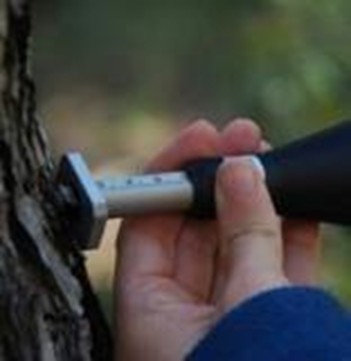
- Extract one or two cores per tree at 1.3 m breast height from opposite sides of the trunk. On sloped terrain, sample perpendicular to the slope; on flat terrain, maintain a consistent orientation.
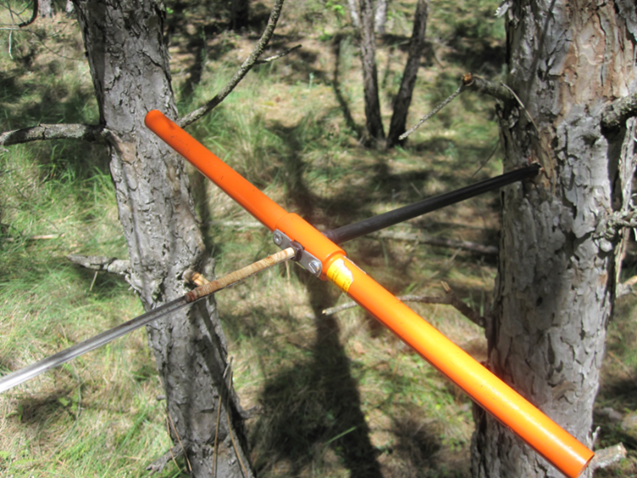
- Drill perpendicularly into the trunk, turning the increment borer smoothly until reaching at least halfway through the stem. Avoid areas where ring patterns may be distorted (e.g., near branches, limbs, knobs, fire scars).
- Carefully remove the core using the extractor, ensuring it remains intact.
- Immediately place the core in a labeled paper straw for protection. Label each paper straw with a unique code, including the site identifier, species code, tree number, and, if applicable, a core identifier (e.g., “Site_Species_Tree_Core”).
- Measure DBH and bark thickness of each selected tree. Record data on a field notebook or electronic device for each selected tree.
- Allow cores to air dry for at least a few days before mounting.It is important to allow cores to air-dry in their straws for several days after collection, as wet cores are prone to shrinkage and cracking if they dry after being mounted and glued.
Core Processing
- Mount each core on a wooden support using water-soluble white glue, ensuring that wood fibers align perpendicular to the field of view. Allow to dry completely before sanding.
- Mark bark and pit side on the wooden support.
- Sand the cores sequentially with a belt sander:
- Start with 120- or 220-grit sandpaper to remove rough fibers.
- Progress through 240- or 320-grit sandpapers.
- Finish with 400-grit sandpaper for maximum visibility of tree rings. Preferable by hand sanding.
- Blow off dust using compressed air to ensure clear ring visibility.
Dating and cross-dating
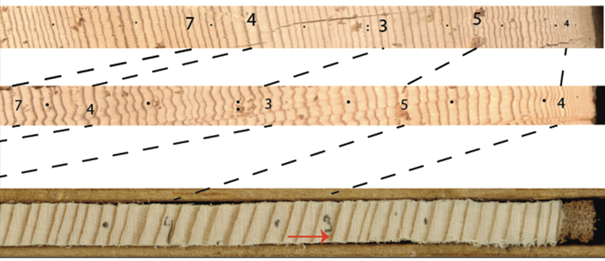
- Starting from the bark and moving toward the pith, mark decade points with a single pinprick, 50-year marks with two pinpricks, and century marks with three pinpricks.
- Within each decade, identify a characteristic tree ring (e.g., a particularly narrow ring) and record its position by counting backward from the tenth ring in the decadal sequence.
- If missing rings are suspected, mark them with an angled double pinprick in the latewood band for reference.
- Arrange cores side by side to visually cross-date samples. Ensure synchrony in ring patterns across trees within the same treatment. Characteristic tree-ring patterns are often consistent among trees within the same plot or region, reflecting shared events such as droughts or severe winters. Reference chronologies can therefore be valuable throughout the sampling campaign when ring interpretation is uncertain.
Ring width measurement and cross-dating validation
- Scan each core at 1200 DPI resolution.
- Use CooRecorder1 to measure tree-ring width.
- Use CDendro1 to save the ring width data for each treatment in Decadal/Tucson .rwl format for COFECHA1 analysis.
- Use COFECHA1 to validate cross-dating.
- Export the final ring width data from CDendro:
- Save as .txt if the data will be analyzed in Excel.
- Save in Decadal/Tucson.rwl format if using the dplR package in R.
1 Refer to the software manual for detailed instruction.
Calculations
Analyzing growth response to burning
For each core, rescale the sum of all ring widths plus the pith offset estimate to match half the measured DBH. This correction, which requires both DBH and bark thickness, accounts for missing rings near the pith and prevents negative basal area increments values.
Convert tree ring width to basal area increment (BAI) for each core to correct for age-related changes in ring width. If two cores were extracted per tree, compute the mean annual BAI. This can be done in Excel or using dplR in R.
\mathrm{BAI}= \pi\left(R_t^2-R_{t-1}^2\right)
After calculating the BAI series for each tree, compute the mean annual BAI by averaging the values across all trees within the same treatment group for each year. This yields a treatment-level growth trend over time, enabling comparisons between different treatment groups, such as underburned and control trees, for instance.
Optional: Following Lloret et al. (2011), you can quantify resistance and resilience to burning:
Resistance to burning (impact of burning, BAIresist):
Interpretation: BAIresist > 1, growth in the year of burning exceeds pre-burning average → higher resistance
Resilience to burning (recovery from burning, BAIresl):
Relation with other methods
Repeated DBH measurements for estimating tree growth
Illustrations
Data templates
NA
Further information
Bakker, J. D. (2005). A new, proportional method for reconstructing historical tree diameters. Canadian Journal of Forest Research, 35(10), 2515-2520.
Bunn, A., Korpela, M., Biondi, F., Campelo, F., Mérian, P., Qeadan, F., … & Schulz, M. (2015). Package ‘dplR’. Dendrochronology Program Library in R, Version, 1(3).
Grissino-Mayer, H. D. (2001). Evaluating crossdating accuracy: a manual and tutorial for the computer program COFECHA.
Lloret, F., Keeling, E. G., & Sala, A. (2011). Components of tree resilience: effects of successive low‐growth episodes in old ponderosa pine forests. Oikos, 120(12), 1909-1920.
Maxwell, R. S., & Larsson, L. A. (2021). Measuring tree-ring widths using the CooRecorder software application. Dendrochronologia, 67, 125841.
Schweingruber, F. H., Eckstein, D., Serre-Bachet, F. and Bräker, O. U. 1990. Identification, presentation and interpretation of event years and pointer years in dendrochronology. Dendrochronologia 8, 9-38.
Stokes, M. A. (1996). An introduction to tree-ring dating. University of Arizona Press.