Basal resprouting ability and vigor of shrub-like individuals
Casals P. 1; Oliveras Menor I.2,3,4
1 Forest Sciences and Technology Centre of Catalonia
2 Montpellier, CIRAD, CNRS, INRAE, IRD), Montpellier, France
3 Leverhulme Centre for Nature Recovery, School of Geography and the Environment, University of Oxford, UK
4 Programa de Pós-Graduação em Ciências Ambientais, UNEMAT, Brazil
Last updated: 24/09/2026
Recommended citation:
Casals P.; Oliveras Menor I.. 2026. Basal resprouting ability and vigor of shrub-like individuals. In: Pere Casals, Davide Ascoli, Lena Vilà-Vilardell, Imma Oliveras, Madoka Krick (eds.) 2026. Methods handbook for characterizing fire use behavior, assessing fire effects, and monitoring soil and vegetation responses at the stand level. FIRE-ADAPT project (number 101086416), deliverable D1.1
Indicator
Ecosystem responses: Vegetation responses
Brief introduction
The capacity to regenerate from a basal bank of protected meristems is an important trait found in a wide range of plant species, enabling individuals to survive and recover after the loss of most of their aboveground biomass (Noble and Slatyer, 1980; Bond and Midgley, 2001). This method is designed to assess the ability and the vigor of woody plants growing in shrub-fuel complexes to recover after a fire through basal resprouting.
Resprouting ability, which is inversely related to individual mortality, can be estimated as the proportion of individuals that resprout after a fire (i.e., yes/no).
Resprouting vigor can be evaluated using metrics such as the number of resprouting shoots emerging from the burned individual base, as well as the length and basal diameter of the resprouts (Casals et al. 2018).
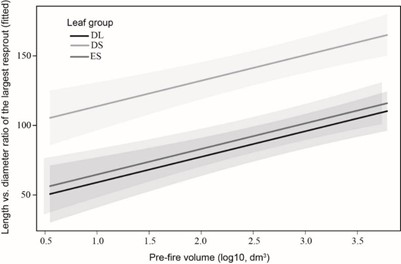
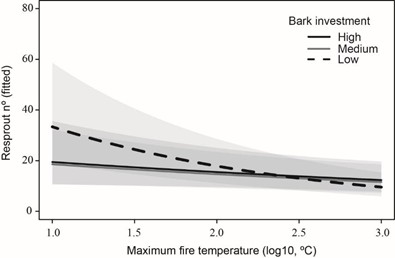
Different mechanisms influence both fire resistance and post-fire resprout growth among species, affecting their capacity to compete for post-fire resources (Casals et al. 2018): The number of resprouts depends on several factors, including pre-fire plant size, relative investment in bark thickness, and the fire severity damage to the lignotuber (e.g., Fig. 1). Following fire, species may adopt contrasting recovery strategies. Some prioritize rapid height growth to avoid being overtopped and shaded by large-leaved competitors (Falster and Westoby, 2005), whereas others invest more in structural support, which can be assessed through measurements of resprout basal diameters (Fig. 2). Measuring pre-disturbance variables, such as plant size, basal area or basal largest diameters, can be useful for comparative studies in fire ecology (Jaureguiberry et al. 2020).
Method specifications
Method type
Soft
Hard
Method timing
Before
fire
During
fire
After fire
(short-term)
After fire
(mid-term)
After fire
(long-term)
Field skills
Low
Medium
Hard
Lab skills
Low
Medium
Hard
Material cost
Low
Medium
Hard
Time cost
Low
Medium
Hard
Calculation expertise
Low
Medium
Hard
Equipment
- Electronic vernier caliper for measuring diameter of resprouts
- Metric tape for measuring the length of resprouts
- Field notebook or electronic device for recording data
Experimental design
Establish a randomly located plot within representative vegetation units. Within each plot, identify the dominant woody species. To assess resprouting ability, individuals should be systematically or randomly selected before fire. In case of unplanned fires, the number of individuals that survive or are killed after at least one year should be estimated relative to the total number of individuals of each species within the transect or plot. A minimum of 50 individuals per species is recommended for estimating resprouting ability.
To assess the resprouting vigor, at least 20 resprouting individuals per species should be sampled. We recommend taking measurements after the growing season.
Because resprouting vigor is influenced by pre-disturbance plant size (e.g., Hodgkinson, 1998;, Casals et al. 2018), selecting individuals of similar size can reduce variability and facilitate comparisons among species and across fire events. Otherwise, it is recommended to estimate pre-disturbance size to reduce intra- and interspecific variability (e. g., Casals et al. 2018; Jaureguiberry et al. 2020).
Methodology
- Establish a representative sampling unit (plot or transect) before the burn or after the event in the case of unplanned fires. The sample unit should contain at least 50 individuals of the target woody species. For Mediterranean forests and shrublands a 30 x 30 m plot is often sufficient to include most of the woody species present in a stand.
- Identify the dominant woody species within the sampling unit. Following a fire, species can be identified by the scorched leaves, bark characteristics or emerging resprouts. If individuals are to be monitored over time, each plant should be clearly identified and marked.
- Assess resprouting ability (yes/no), by recording, for each species, the number of individuals that resprout after fire relative to the total number of individuals present in the sampling unit.
- Count the number of resprouts per stump.
- Measure resprout length by recording the length of at least the ten largest resprouts per individual, from their point of origin to the tip of the stem (in cm, accuracy ±0.2 cm). If the measures are taken during the growing season, consider excluding or not the current year’s growth to improve comparability among assessments in different seasons.
- Measure resprout diameter at the base of at least the ten largest resprouts, using the electronic caliper (in mm, accuracy ±0.5 mm).
- Optionally, characterise pre-fire plant size. Before fire, estimate the apparent volume using the maximum and orthogonal crown diameters, and plant height. Basal area can be estimated from stem basal diameters. In case of unplanned fires, basal area may be estimated retrospectively measuring the diameters of burned stems.
Calculations
We recommend assessing resprouting ability and vigor at least 1 and 3 y after the fire.
For each resprouting individual, calculate the maximum and median resprout diameter and length. Subsequently, calculate the mean and standard deviation for each species.
Basal area (BA) of each resprouting individual can be calculated as the sum of the basal area of each resprout (i) estimated from the basal diameter (Bd(i)):
BA=\sum_{1}^{n}\pi\left(\frac{Bd(i)}{2}\right)^2
Resprout volume can be calculated by summing the volumes of cylinders calculated from the basal area and the length of each resprout. For stumps with more than ten resprouts, the volume of the rest of the resprouts can be calculated by multiplying the number of resprouts with the minimum resprout volume of the ten measured resprouts.
The Resprouting capacity index (RC1, Jaureguiberry et al. 2020) can be calculated as the ratio of the largest resprout diameter and the largest burned trunk diameter.
Relation with other methods
NA
Illustrations
Data templates
NA
Further information
Bond, W.J., Midgley, J.J., 2001. Ecology of sprouting in woody plants: the persistence niche. Trends Ecol. Evol. 16, 45–51.
Casals, P., Valor, T., Ríos, A. I., Shipley, B. 2018. Leaf and bark functional traits predict resprouting strategies of understory woody species after prescribed fires. For. Ecol. Manage. 429, 158-174.
Falster, D.S., Westoby, M., 2005. Alternative height strategies among 45 dicot rain forest species from Queensland, Australia. J. Ecol. 93, 521–535.
Hodgkinson, K.C., 1998. Sprouting success of shrubs after fire: height-dependent relationships for different strategies. Oecologia 115, 64–72.
Jaureguiberry, P., Cuchietti, A., Gorné, L.D., Bertone, G.A., Díaz, S. 2020. Post-fire resprouting capacity of seasonally dry forest species – Two quantitative indices. For. Ecol. Manage. 473, 118267
Noble, I.R., Slatyer, R.O., 1980. The use of vital attributes to predict successional changes in plant communities subject to recurrent disturbances. Vegetatio 43, 5-21.
Type your paragraph here