Destructive sampling for litter and duff fuel load C stocks and fire driven changes
Garcia-Pausas, J.1; Casals P.1
1Forest Science and Technology Centre of Catalonia (CTFC)
Last updated: 25/09/2026
Recommended citation:
Garcia-Pausas, J. & Casals P. 2026. Destructive sampling for litter and duff fuel load C stocks and fire driven changes. In: Pere Casals, Davide Ascoli, Lena Vilà-Vilardell, Imma Oliveras, Madoka Krick (eds.) 2026. Methods handbook for characterizing fire use behavior, assessing fire effects, and monitoring soil and vegetation responses at the stand level. FIRE-ADAPT project (number 101086416), deliverable D1.1
Indicator
Fuel load: Ground fuel load
Brief introduction
The forest floor is composed of the organic layers, consisting of undecomposed litter to completely humified organic matter that accumulates above the mineral soil in most forested ecosystems. Organic forest floor can be separated into different layers according to its decomposition status. Three organic layers are usually considered: The L (or Oi) layer, corresponding to recently fallen leaves and fine branches (<1 year old); the F (Oe) layer corresponding to fragmented and moderately decomposed leaves and fine branches; and the H (Oa) layer, corresponding to highly decomposed organic material, in which it is difficult to recognize the original tissues and structures. Collecting separate samples of each organic layer (L, F, H) will allow a better understanding of the organic matter dynamics and increase the precision of C stocks estimates. The ability to separate each organic layer comes with practice but, even for experienced technicians, sometimes it is difficult to completely separate F from L or H in the field. Therefore, it is recommended to sieve each layer in the laboratory to better classify the organic floor into each layer.
The method consists in separately collecting L, F and H layers in at least 15 microsites per stand.
Method specifications
Method type
Soft
Hard
Method timing
Before
fire
During
fire
After fire
(short-term)
After fire
(mid-term)
After fire
(long-term)
Field skills
Low
Medium
Hard
Lab skills
Low
Medium
Hard
Material cost
Low
Medium
Hard
Time cost
Low
Medium
Hard
Calculation expertise
Low
Medium
Hard
Equipment
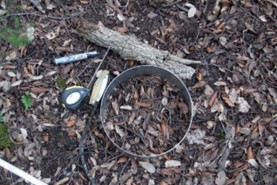
1-2 Circular or square frames of ca. 25-30 cm diameter1
Paper bags for collecting samples
A tap to record layer depth
A sieve with 4 mm mesh size
Lab balance (precision: 0.1g)
1 The size of the frame depends on the size of the leaves. A frame of 25-30 cm diameter is enough for leaves of 15 cm length.
Experimental design
At least 15 microsites in a regular grid. Each microsite should be separated at least by about 5 m. Any microsite with detected disturbance (e.g. by wild boars) in the organic layer should be avoided. Each microsite can be marked adequately, or coordinates recorded with a sub-metric GPS for future samplings.
Methodology
- Systematically locate the microsites avoiding non-representative locations (i.e., rock, tree base)
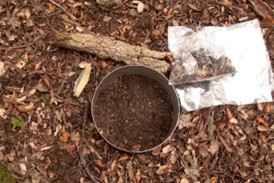
- Collect separately L, F and H layers within a 25-30 cm diameter frame1. Any live plant material, coarse branches or cones inside the frame should be discarded2. Each sample should be identified indicating the grid position, locality, data, and layer. The depth of each sample can be recorded.
- Dry the samples in the air or in an oven (60 ºC) and store.
- Because it is not easy to discern the F and H layers in the field, we propose to sieve the H layer with a mesh size of 4 mm and consider the organic material above this size as F fraction. Fragmented, semidecomposed leaves and wood material eventually collected as L fraction should be also added to this F fraction. If small needles pass through the 4mm sieve, manually collect them and put it back to the F layer.
- Weigh the samples after sieving.
- Weigh a subsample of each sample before and after oven-dry (100ºC) it until constant weight. This ratio is used to calculate the dry weight of each layer (100ºC) (see point a in Calculactions section).
- To express the weight of each sample in g m–2 (see point in Calculactions section).
- To express the weight in terms of organic carbon, a subsample of each sample must be analyzed using standardized laboratory methods. Due to the OC variability, we recommend analyzing the OC of each H sample. To reduce the cost of analysis, three composite samples per each L or F layer can be analyzed.
1 The size of the frame depends on the size of the leaves. A frame of 25-30 cm diameter is enough for leaves of 15 cm length.
2 The method is not robust to estimate coarse woody material.
Calculations
a) To calculate the dry mass (at 100ºC) multiply the weight from point (5) with the weight of the subsample after oven-dry at 100ºC and divide by subsample weight before oven-dry.
b) To calculate the mass of each organic layer mass (g m-2) of each sample divide the sample mass (g) by the area of the sample frame (m2). The mass of each layer in the stand (g m–2) can be estimated by the median and the interquartile range.
Relation with other methods
Burn depth consumption is less accurate but useful to estimate the amount of organic layer consumed by fire.
The present method can be combined with the Gravimetric weighing of living and dead fuel for fuel moisture content determination method if the moisture content of growth fuel is also a topic of interest.
Illustrations
Data templates
NA
Further information
Burton AJ, Pregitzer KS. 2008. Measuring Forest Floor, Mineral Soil, and Root Carbon Stocks. In: Hoover CM (Ed.) Field Measurements for Forest Carbon Monitoring. A Landscape Scale Approach. Springer
Fons J, Sauras T, Romanyà J, Vallejo VR. 1997. Sampling strategies in forest soils. Ann For Sci 54: 493-499
Kristensen T, Ohlson M, Bolstad P, Nagy Z. 2015. Spatial variability of organic layer thickness and carbon stocks in mature boreal forest stands–implications and suggestions for sampling designs. Environ Monit Assess 187: 52