Skip to content

Gravimetric weighing of living and dead fuel for fuel moisture content determination

Vilà-Vilardell, L.1; Casals P.1

1Forest Science and Technology Centre of Catalonia (CTFC)

Last updated: 07/08/2026

Indicator

Fuel flammability: Fuel moisture content

Brief introduction

Fuel moisture content (FMC) is defined as the mass of water per unit mass of dry material and is often expressed as a percent.  This method describes how to estimate the FMC of live fine fuel, dead fuels, litter and duff by weighing fresh samples, and reweighing them after oven-drying the samples. FMC of living fuels is driven by the physiological features of plants, while in dead fuel it is driven by the physical characteristics such as particle size, density and shape. Dead fuel has traditionally been grouped according to diameter classes (time-lags). Fuel ignition and flammability is mostly related to the amount and moisture of fine class diameter (<6 mm); While fine and medium fuel classes (<7.5 mm) contributes to fire intensity, coarse classes mostly contribute to the smoldering phase of fire and to the smoke production. Litter and duff dryness are related to susceptibility to being consumed by fire. FMC dynamics of litter and duff are quite different from dead fuel and depends on the type, depth and stage (Keane 2015).

Method specifications

Method type

Soft

Hard

Method timing

Before
fire

During
fire

After fire 
(short-term)

After fire
(mid-term)

After fire
(long-term)

Field skills

Low

Medium

Hard

Lab requirements

Low

Medium

Hard

Analysis cost

Low

Medium

Hard

Fungible material cost

Low

Medium

Hard

Time cost

Low

Medium

Hard

Calculation expertise

Low

Medium

Hard

Required equipment

  • Sealed containers or bags2 identified on their body and lid
  • Shears (to clip small branches)
  • Garden trowel to collect duff
  • Oven (ideally: 100ºC)
  • Lab balance (precision: 0.1g)

Experimental design

For live fuel moisture content, a minimum of 3 samples should be collected for each of the main vegetation species present in the stand. Each sample should consist of about 8 branches of different individuals. Each sample is stored in a sealed identified container.

For dead fuel moisture content1, collect woody fine fuel, litter, and duff samples at 15 points across the stand or in a regular grid, and composited in 3 sealed containers per fraction.

1 Although not strictly related to fuel flammability, 0-5 cm of mineral soil can be also sampled as an additional fraction if we expect a severe surface fire with potential impact on mineral soil organic matter.

Methodology

1. Identify the main species in the stand, including trees, shrubs, and herbaceous species.

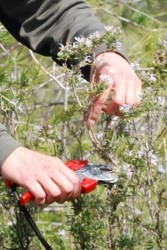
2. For living fuel: Clip a branch, exposed to the sun, with healthy leaves at a diameter of 5-6 mm from at least 6 individuals of each identified species; remove fruits and flowers and store them in a sealed container (~1 L). Collect at least 3 containers (18 individuals in total).

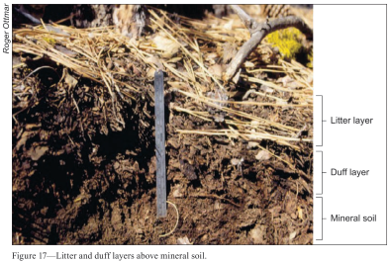
3. For dead fine fuel, and duff1: Collect all fine woody fuels (< 6 mm), litter, and duff in separate sealed containers in at least 15 sampling points distributed regularly spaced (e.g. 5 m intervals) in a transect or a regular grid (e.g., 20 × 20 m square grid). For each fraction, a composite sample of every 5 sampling points is stored in a sealed container. A total of 3 containers per fraction is obtained.

4. In the lab, weigh the containers with the sample and lid (or transfer the sample into trays and weigh them2). This is wet weight of samples (which includes the container with the lid).

5. Place the open containers with their identified lids in an oven at 80 ºC3 to constant dry weight (~ 48 hours for fine particles, while depends on the humidity for duff and coarse particles).

6. Remove the containers from the oven and cover them with their corresponding lid to avoid that dry samples take up moisture from the air4. Weigh the containers with the dried sample and lid. This is dry weight of sample (with the container and lid).

7. Remove the samples, clean and weigh the empty container with the lid. This is the container tare weight.

8. Calculate the moisture content of the sample after subtracting the container and lid weight using the formula below.

9. For living fuel, dry samples are separated into leaf (Lw) and stem (Sw) fractions and weighted. The leaf-to-stem (LSR) percent ratio is obtained to inform about the dynamics of fuel load or the level of branch defoliation.

1 Although not strictly related to fuel flammability, 0-5 cm of mineral soil can be also sampled as an additional fraction if we expect a severe surface fire with potential impact on mineral soil organic matter.

2 Ideally glass or plastic containers that resist the heat of the stove in order to include the amount of water transpired or released between the sampling and the lab.

3 Higher temperatures (~100 ºC) and longer periods (>48 h) alter the organic structure of fuel components and organic compounds start to volatilize.

4 Be aware that dry samples take up moisture from the air as they cool down.

Field data sheets

Link to data sheet (NA)

Special calculations

\mathrm{FMC}(\%)= \frac{W_w-W_d}{W_d-W_t}\times100

\begin{array}{l} \textbf{Where:} \\[0.5em] \mathrm{FMC} = \text{Fuel moisture content} \\ W_w = \text{Sample wet weight} \\ W_d = \text{Sample dry weight} \\ W_t = \text{Container tare weight} \end{array}
\mathrm{LSR}(\%)= \frac{Lw}{Sw}\times100
\begin{array}{l} \textbf{Where:} \\[0.5em] \mathrm{LSR} = \text{Leaf-to-stem ratio} \\ Lw = \text{Leaf fraction dry weight} \\ Sw = \text{Stem fraction dry weight} \end{array}

Relation with other methods

Bend test for estimating moisture content of leaf litter or fine slash.

Remote automated system for measuring fine dead fuel moisture.

Photos

From Prichard et al. (2019).

Further information

Gabriel E, Delgado-Dávila R, De Cáceres M, Casals P, Tudela A, Castro X. 2021. Live fuel moisture content time series in Catalonia since 1998. Annals of Forest Science, 78: 44.

Keane R.E. 2015. Wildland fuel fundamentals and application. Springer Intern. Switzerland. ISBN 978-3-319-09015-3

Pollet, J.; Brown, A. 2007. Fuel moisture sampling guide. Salt Lake City, UT: U.S. Department of Interior, Bureau of Land Management, Utah State Office. 30 p

Prichard, S. J., Andreu, A. G., Ottmar, R. D., & Eberhardt, E. (2019). Fuel Characteristic Classification System (FCCS) field sampling and fuelbed development guide. Gen. Tech. Rep. PNW-GTR-972. Portland, OR: US Department of Agriculture, Forest Service, Pacific Northwest Research Station. 77 p., 972.

Zahn, S.; Henson, C. 2011a. A synthesis of fuel moisture collection methods and equipment—a desk guide. 1151 1806P. San Dimas, CA: U.S. Department of Agriculture, Forest Service, San Dimas Technology and Development Center. 31 p. https://www.fs.usda.gov/t-d/pubs/pdf/11511806.pdf

Zahn, S.; Henson, C. 2011b. Fuel moisture collection methods: a field guide. 11511803P. San Dimas, CA: U.S. Department of Agriculture, Forest Service, San Dimas Technology and Development Center. 11 p. https://www.fs.usda.gov/t-d/pubs/pdf/11511803.pdf