Skip to content

Litter traps during the peak of litterfall

Bacciu, V.1

1Consiglio Nazionale delle Ricerche – Istituto per la BioEconomia

Last updated: 28/09/2026

Recommended citation:

Bacciu, V. 2026. Litter traps during the peak of litterfall. In: Pere Casals, Davide Ascoli, Lena Vilà-Vilardell, Imma Oliveras, Madoka Krick (eds.) 2026. Methods handbook for characterizing fire use behavior, assessing fire effects, and monitoring soil and vegetation responses at the stand level. FIRE-ADAPT project (number 101086416), deliverable D1.1

Indicator

Ecosystem responses: Vegetation responses

Fuel load: Surface fuel load

Brief introduction

Litterfall is a key component of forest biogeochemical cycles, regulating the return of organic matter and nutrients to the soil and influencing soil fertility, nutrient cycling, and forest productivity. Its quantity and seasonal dynamics are affected by climatic conditions, environmental stressors, and biotic disturbances such as prescribed burnings, making it a valuable indicator of forest vitality. Moreover, litterfall provides important information on carbon cycling, phenological development, and tree health through the analysis of fallen leaves and reproductive structures.

Method specifications

Method type

Soft

Hard

Method timing

Before
fire

During
fire

After fire 
(short-term)

After fire
(mid-term)

After fire
(long-term)

Field skills

Low

Medium

Hard

Lab skills

Low

Medium

Hard

Material cost

Low

Medium

Hard

Time cost

Low

Medium

Hard

Calculation expertise

Low

Medium

Hard
Equipment

  • Litter traps

  • Paper bags

  • Laboratory oven

  • Precision scale (0.01 g accuracy)

Experimental design

A minimum of 10–20 traps per study site should be installed. Traps are spaced sufficiently apart (e.g., 10–20 m) to ensure independent sampling and are permanently marked for repeated collections.

Methodology

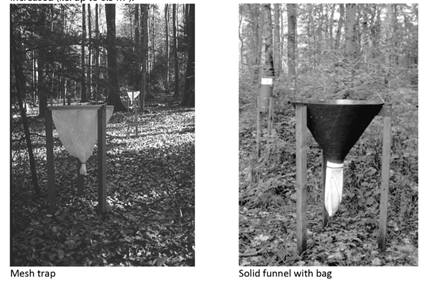
  1. Each litter trap consists of a square or circular frame with a collection area of 0.25–1.0 m² (commonly 0.5 m²) fitted with a fine nylon or polyethylene mesh (approximately 1–2 mm mesh size) to allow water drainage while retaining litter. Traps are suspended 0.5–1.0 m above the ground to minimize contamination from surface litter and reduce access by ground-dwelling animals. 
  2. During the peak litterfall period or after prescribed burning, litter is collected at weekly intervals (or every 7–14 days, depending on litter accumulation rates). Frequent collection minimises decomposition, moisture accumulation, wind losses, and overflow of collected material.
  3. Collected litter is transported to the laboratory in labelled paper bags. Samples are cleaned of insects, soil, and other foreign materials before being sorted into categories such as: Leaves, Twigs (≤2 cm diameter), Reproductive material (flowers, fruits, seeds), Bark, Miscellaneous debris.
  4. Each fraction is oven-dried at 65–70°C until constant weight (typically 48–72 hours) and weighed to the nearest 0.01 g using a precision balance.

Calculations

Litterfall is expressed as dry mass per unit area.

Results are reported as g m⁻² collection⁻¹, g m⁻² week⁻¹, or converted to Mg ha⁻¹ yr⁻¹ when estimating annual litter production. Mean litterfall and standard errors are calculated across traps for each sampling period.

\mathrm{Litterfall}(\mathrm{g\,m^{-2}})= \frac{W_d}{A_{\mathrm{trap}}}

\begin{array}{l} \textbf{Where:} \\[0.5em] \mathrm{W_d} = \text{Sample dry weight} \\ A_{\mathrm{trap}} = \text{Trap area}  \end{array}

Relation with other methods

NA

Illustrations

Example of litterfall collectors (from Pitman et al., 2010)

Data templates

NA

Further information

Helene C. Muller-Landau and S. Joseph Wright (2010) Litterfall Monitoring Protocol CTFS Global Forest Carbon Research Initiative, https://forestgeo.si.edu/sites/default/files/litterfall_protocol_2010.pdf

Rona Pitman, Anne-Marie Bastrup-Birk, Nathalie Bréda, Pasi Rautio (2010) Sampling and analysis of litterfall. Manual on methods and criteria for harmonized sampling, assessment, monitoring and analysis of the effects of air pollution on forests: Part XIII, ICP Forests, 2010, 978-3-926301-03-1, https://hal.inrae.fr/hal-02815080v1/document