Measuring changes in forest floor thickness
Casals, P.1; Garcia-Pausas, J. 1
1 Forest Sciences and Technology Centre of Catalonia
Last updated: 28/09/2026
Recommended citation:
Casals P. & Garcia-Pausas J. 2026. Measuring changes in forest floor thickness. In: Pere Casals, Davide Ascoli, Lena Vilà-Vilardell, Imma Oliveras, Madoka Krick (eds.) 2026. Methods handbook for characterizing fire use behavior, assessing fire effects, and monitoring soil and vegetation responses at the stand level. FIRE-ADAPT project (number 101086416), deliverable D1.1
Indicator
Fire Severity: Severity on Soil
Brief introduction
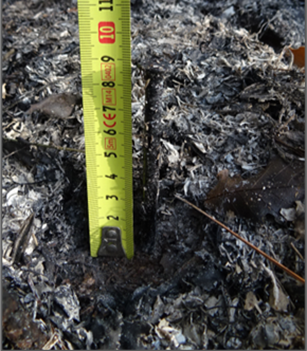
Forest floors consist of a layer of organic material at different stages of decomposition, ranging from recently fallen non woody material (Litter1, L layer) to more decomposed organic material (Duff2: F and H layers). The forest floor represents a significant proportion of total soil carbon stocks and, therefore, fires – especially those that spread through surface or ground fuels – can have a major impact on ecosystem carbon losses. Post-fire organic-layer depth can also influence regeneration and species recruitment patterns (e.g., Greene et al. 2006). This method is designed to assess the severity on forest floors by comparing the thickness of organic layers before and after a fire, using a nail or metal rod inserted into the soil as a reference (Fig. 1).
Because forest floor layers differ in packing ratio (i.e., bulk density) and other physical and chemical characteristics, it is necessary to estimate changes in thickness for each layer3, if changes in carbon content are to be quantified. Layer thickness is related to carbon content through bulk density. Equations for converting thickness measurements into organic carbon stocks are provided in Method 2.5. Changes in C stocks can be estimated by multiplying layer thickness by bulk density.
After a fire, the soil surface may be covered by ash derived from aboveground vegetation and the combustion of the forest floor. Although the concentration of organic C in white ash is generally low, it can be substantial in partially carbonized material (black ash). In such cases, the thickness of black ash and partially charred material should be measured, and a field assessment should determine whether these materials represent partially burned forest floor or deposits originating from burned aboveground vegetation. In the former case, their C stocks should be estimated.
The main advantages of this method are its simplicity, low cost, and ability to assess the spatial variability of fire severity. It can also be readily adapted to estimate changes in leaf litter accumulated around the bases of trees, or in fuel resulting from forestry treatments such as mastication.
1 Litter consists of recently fallen, identifiable, non-woody dead organic material, referred to as L horizon (Soil Classification Working Group, 1998). It includes leaves, dead grass blades, bud scales, and pollen cones, but excludes woody debris (e.g., cones and branches) which is typically assessed separately because of its spatial distribution, physical and chemical properties, and combustion characteristics (Keane, 2015). Litter is primarily consumed during the flaming phase. Dead or dry mosses and lichens may also be included in this layer.
2Duff is the layer of decomposing organic material located between the litter and the mineral soil (Keane, 2015). It can be subdivided into the fermentation layer (F layer), where the origin of some particles remains identifiable, and the humus layer (H layer), where organic material has largely lost its original structure.
3 In the field, distinguishing boundaries between layers can be challenging. Differences in material density, moisture content, and combustion characteristics can be used as practical criteria for assigning material to a particular layer.
Method specifications
Method type
Soft
Hard
Method timing
Before
fire
During
fire
After fire
(short-term)
After fire
(mid-term)
After fire
(long-term)
Field skills
Low
Medium
Hard
Lab skills
Low
Medium
Hard
Material cost
Low
Medium
Hard
Time cost
Low
Medium
Hard
Calculation expertise
Low
Medium
Hard
Equipment
- Metallic rods or nails of length higher than the organic layer thickness
- Sub-metric GPS(optional to locate the nails)
- Measuring tape
- Metal detector (optional to find the nail after burning)
- Field notebook or electronic device for recording data
Experimental design
Establish a randomly located plot or a transect4 within representative units. Within each plot, rods may be distributed systematically or stratified according to different criteria, such as forest floor thickness categories or type. Given the expected variability in fire behavior, at least 20 rods should be deployed for each criterion. For specific objectives, such as assessing thickness changes beneath different shrub species or around the bases of trees, rods should be arranged accordingly.
At a minimum, the thickness of the litter1 and duff2 layers must be measured independently in each metallic rod3.
1 Litter consists of recently fallen, identifiable, non-woody dead organic material, referred to as L horizon (Soil Classification Working Group, 1998). It includes leaves, dead grass blades, bud scales, and pollen cones, but excludes woody debris (e.g., cones and branches) which is typically assessed separately because of its spatial distribution, physical and chemical properties, and combustion characteristics (Keane, 2015). Litter is primarily consumed during the flaming phase. Dead or dry mosses and lichens may also be included in this layer.
2Duff is the layer of decomposing organic material located between the litter and the mineral soil (Keane, 2015). It can be subdivided into the fermentation layer (F layer), where the origin of some particles remains identifiable, and the humus layer (H layer), where organic material has largely lost its original structure.
3 In the field, distinguishing boundaries between layers can be challenging. Differences in material density, moisture content, and combustion characteristics can be used as practical criteria for assigning material to a particular layer.
4 Plot or transect sizes depend on the area burned and the variability of forest floor thickness: a 20 m x 20 m or a transect of 100 m, with about 20 rods can be enough for dense Mediterranean forest or shrublands.
Methodology
- Before the burn, insert the metal rod on the sampling unit and unequivocally identify them. The rod must be nailed to the mineral horizon to prevent it from falling after the fire.
- Measure the distance (accuracy ±0.2 cm) between the top of the metal rod and the litter surface (DL0) and the distance between the top to the lower limit of the litter1 (DL1), trying not to disturb the arrangement of the layer.
- After the burn, measure the distance between the top of the metal rod and the surface of ashes (DA0) and the distance between the top and the lower limit of the ashes (DA1), and the distance to the lower limit of the duff layer not consumed (DH1).
- Optionally, it can be useful to volumetrically collect the ashes to estimate the bulk density and analyse the organic C to estimate C stock in the ashes.
Calculations
Thickness of organic layers (Litter Lt, Duff Ht and Ash At; in cm):
Consumption of organic layers (cm):
- Absolute forest floor consumption (FFc):
FF_c=DA_1-DL_0
- Litter consumption (Lc, in cm):
- Duff consumption (Hc, in cm):
H_c=DH_1-DA_1
Difference relative in the organic cover thickness (%):
- Relative consumption of litter layer:
RL_c=\frac{L_c\times100}{L_t}
- Relative consumption of duff:
RH_c=\frac{H_c\times100}{H_t}
Relation with other methods
The equations described in method “ Garcia-Pausas et al. Estimation of forest floor C pools by measuring organic layer thickness” allow to estimate C losses due to the changes in thickness using the bulk density relations provided for recent fallen litter (L) and duff (H horizon).
The impact of fire on organic layers varies depending on different factors, being the time of combustion and the humidity of organic layers the most important ones (e.g., Miyanishi 2001). Estimating these indicators can help in understanding the changes observed in the forest floor.
Illustrations
Data templates
NA
Further information
Greene D.F., et al. The reduction of organic-layer depth by wildfire in the North American boreal forest and its effect on tree recruitment by seed. Canadian Journal of Forest Research, 37: 1012-1023.
Keane, R. E. 2015. Wildland fuel fundamentals and applications. Springer. ISBN 978-3-319-09015-3 (eBook)
Miyanishi, K. 2001. Duff consumption. In: Forest fires: behavior and ecological effects. Miyanishi K. and Johnson E.A. (eds). Academic Press. San Diego. Pp. 437-475.
Soil Classification Working Group (1998) The Canadian System of Soil Classification. Agriculture and Agri-Food Canada, Soil Classification Working Group, 3rd ed. The Canadian System of Soil Classification, 187 p.