Skip to content

Remote automated system for measuring fine dead fuel moisture

Pellizzaro G.1, Ventura A.1, Arca A.1, Arca B.1

1National Research Council of Italy – Institute for the BioEconomy

Last updated: 23/09/2026

Recommended citation:

Pellizzaro G., Ventura A., Arca A., & Arca B. 2026. Remote automated system for measuring fine dead fuel moisture. In: Pere Casals, Davide Ascoli, Lena Vilà-Vilardell, Imma Oliveras, Madoka Krick (eds.) 2026. Methods handbook for characterizing fire use behavior, assessing fire effects, and monitoring soil and vegetation responses at the stand level. FIRE-ADAPT project (number 101086416), deliverable D1.1

Indicator

Fuel flammability: Fuel moisture content

Brief introduction

Dead fine fuel moisture content (FMC) is a key factor in determining wildfire ignition and behaviour: the higher the fine fuel moisture content, the more energy needed to evaporate the moisture before the fuels can ignite.

This variable is always present in several fire danger indices such as the National Fire Danger Rating System (NFDRS) or the Canadian Forest Fire Danger Rating System. Accurate and up-to-date measurements of dry fuel moisture are difficult to obtain because common methods involve manual sampling in the field and oven drying, which results in delayed availability of results. Electronic systems for the continuous measurement of dead fuel moisture are currently available on the market and allow this data to be acquired on an hourly basis. A network of sensors that monitor the moisture content of dead fuel provides continuous, up-to-date information, particularly on days with severe weather conditions1. This improves the ability to estimate the risk of forest fires.

1 A prototype network for monitoring dead fuel moisture (10h) using automatic measurement sensors was set up in Sardinia by CNR IBE as part of the Interreg PROTERINA-DUE project and successively upgraded as part of the Interreg MED-Star2 project (European Cooperation Program INTERREG IT-FR Maritime/Marittimo 2007-2013). Each measuring system is autonomous and was assembled by staff from the CNR’s IBE.

Method specifications

Method type

Soft

Hard

Method timing

Before
fire

During
fire

After fire 
(short-term)

After fire
(mid-term)

After fire
(long-term)

Field skills

Low

Medium

Hard

Lab skills

Low

Medium

Hard

Material cost

Low

Medium

Hard

Time cost

Low

Medium

Hard

Calculation expertise

Low

Medium

Hard
Equipment

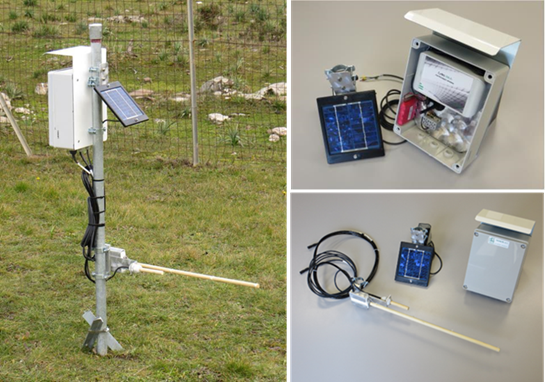
The automated remote measuring system consists of:

  • One 10 h fuel moisture stick (in Pinus Ponderosa)2 connected to a fuel moisture sensor developed by Campbell Scientific Inc.
  • One fuel temperature stick (in Pinus Ponderosa) connected to a temperature probe developed by Campbell Scientific Inc.

  • One mounting stake
  • One data logger

The power supply system consists of:

  • One 5W solar panel with support 
  • One 6 V DC/2 Ah backup battery (AA)
  • One web-based data transmission system

2 Pinus ponderosa is the same type of wood traditionally used for making the standard fuel moisture indicator sticks. These sticks, of known dry weight, are continuously exposed to the weather and periodically weighed to estimate the moisture content of dead fuels, which is required for calculating the National Fire-Danger Rating System in the United States

Experimental design

Measurement sites should be selected based on exposure, altitude, geographical characteristics, as well as the frequency of fires in the area under consideration in order to obtain a network that represents different environmental conditions. It is also advisable to select measurement sites close to meteorological stations.

Methodology

The network should be set up in three stages:

  1. Identification of the measuring locations.
  2. Installation of the measuring system. Each system is capable of acquiring fuel moisture and temperature data on an hourly basis. The acquisition system is completely autonomous and consists of: a pair of sensors for measuring moisture and temperature for a standard fuel (Pinus ponderosa); a power supply system with a 5W solar panel and a 6Vdc/2Ah backup battery, AA; a data logger complete with SIM card.
  3. Installation of a web-based transmission system that automatically communicates via modem to an FTP server where the data is stored.

Relation with other methods

NA

Illustrations

Remote automated system for measuring fine dead fuel moisture, power supply system, data storage and transmission system and fuel sensor details
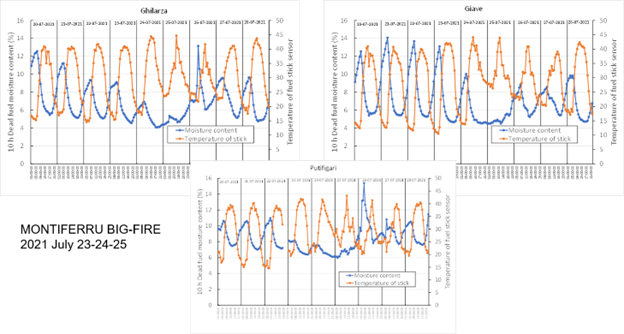
Trends in dead fuel moisture and temperature recorded at three different locations in Sardinia during the days affected by the Montiferru big-fire in 2021

Data templates

Link to template (NA)