Skip to content

Repeated DBH measurements for estimating tree growth

Valor T.1

1 Department of Agri-Food Engineering and Biotechnology, Universitat Politècnica de Catalunya-BarcelonaTech, Castelldefels, Spain

Last updated: 24/09/2026

Recommended citation:

Valor T. 2026. Repeated DBH measurements for estimating tree growth. In: Pere Casals, Davide Ascoli, Lena Vilà-Vilardell, Imma Oliveras, Madoka Krick (eds.) 2026. Methods handbook for characterizing fire use behavior, assessing fire effects, and monitoring soil and vegetation responses at the stand level. FIRE-ADAPT project (number 101086416), deliverable D1.1

Indicator

Ecosystem responses: Vegetation responses

Brief introduction

This method is designed to assess post-burning tree growth. It involves selecting focal trees on selected treatments, georeferencing them, and measuring their diameter at breast height (DBH) during repeated surveys to estimate annual diameter increment (cm/year). Although it does not capture the detailed intra-annual growth patterns provided by increment core analysis (Coring tree for assessing tree growth changes), this method delivers an average annual growth rate, offering a valuable overview of tree vigour and general growth trends following burning, especially if applied  across different treatments.

Method specifications

Method type

Soft

Hard

Method timing

Before
fire

During
fire

After fire 
(short-term)

After fire
(mid-term)

After fire
(long-term)

Field skills

Low

Medium

Hard

Lab skills

Low

Medium

Hard

Material cost

Low

Medium

Hard

Time cost

Low

Medium

Hard

Calculation expertise

Low

Medium

Hard

Equipment

  • Tape diameter (0,1 mm accuracy)
  • Color spray 
  • Sub-metric GPS and/or numbered metal tags for tree identification

Experimental design

For each species, select a minimum of 30 focal trees per treatment. Treatments should be chosen based on their relevance to the monitoring objectives. For instance, trees that have undergone prescribed burning, control/unburned trees, trees exposed to different levels of fire severity (e.g., those with 30% crown scorch), among others.  The inclusion of unburned/control trees is strongly recommended for comparison purposes.

To ensure a valid comparison between treatment groups, select trees with similar initial DBH, unless DBH itself is the focus of a treatment group. In such cases, ensure that trees within each group are comparable in size. This approach helps isolate the effects of burning from any size-related growth differences.

Focal trees should be spaced as far apart as possible within the plot to minimize spatial autocorrelation. Each tree must be clearly labeled, and its coordinates recorded using a sub-metric GPS system to facilitate future surveys.
Methodology

  1. Before burning, select 30 focal trees per treatment group. Refer to the experimental design for an example of treatment groups.
  2. Attach a numbered metal tag to each tree for easy identification.
  3. Record the precise location of each tree using a sub-metric GPS to ensure accurate future mapping.
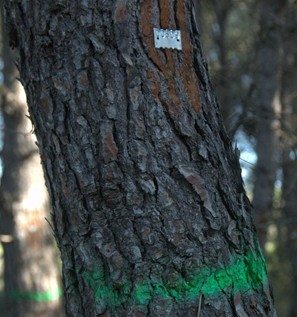
  4. Immediately after burning 1, mark a clear line at breast height on each tree using spray paint to standardize measurement height.
  5. Measure the DBH using a diameter tape, aligning it with the spray-marked line. For trees on slopes, take the measurement from the upper side of the slope.
  6. The survey can be repeated at any desired interval. It is recommended to repeat the survey every five years, but it can be adjusted based on monitoring needs. Re-mark the trees with spray paint every five years, as the original markings may fade over time.

1 DBH measurements and spray marking can also be made just before the burn. However, the line may be obscured by char after the burn. If measurements are taken before the burn, ensure that the line is still visible after the fire and re-mark it if necessary.

Calculations

For each treatment and tree, calculate the tree’s annual diameter increment (cm/year) by dividing the total DBH increase (in cm) by the number of years between consecutive surveys.

Relation with other methods

This method is less accurate but less costly than coring (Coring tree for assessing tree growth changes) or mechanical dendrometers. It can be also applied extensively to have spatial information of tree growth.

Illustrations

Numbered metal tag for identification.

Data templates

NA