The cube method for destructive sampling of shrub canopies
Fernades, P.M.1
1Centro de Investigação e Tecnologias Agroambientais e Biológicas, Universidade de Trás-os-Montes e Alto Douro
Last updated: 24/09/2026
Recommended citation:
Fernandes, P.M. 2026. The cube method for destructive sampling of shrub canopies. In: Pere Casals, Davide Ascoli, Lena Vilà-Vilardell, Imma Oliveras, Madoka Krick (eds.) 2026. Methods handbook for characterizing fire use behavior, assessing fire effects, and monitoring soil and vegetation responses at the stand level. FIRE-ADAPT project (number 101086416), deliverable D1.1
Indicator
Fuel flammability: Fuel structure
Brief introduction
Detailed quantitative characterization of fuel structure, namely through variables describing size-class distribution, (dis)continuity, aeration and packing, is useful to estimate fuel load by category and is crucial for fire behaviour modelling. The cube method was devised for the destructive sampling of shrub canopies at the level of individual shrubs or shrub thickets (Cohen et al., 2002; Mårell et al., 2008). It enables modelling the spatial distribution of fuel particles within the canopy by sampling across its vertical dimension: “top” cubes representing the outermost canopy almost entirely consisting of fine live fuel; “center” cubes accounting for the innermost part of the canopy, typically with intermediate fractions of foliage and twigs and, depending on species, live and dead fuels; and “bottom” cubes representing the lower interior parts of the canopy with higher proportions of coarser elements and necromass.
The collected data allows calculation of bulk density, packing ratio and fuel load, which can further be categorized by live and dead condition.
Method specifications
Method type
Soft
Hard
Method timing
Before
fire
During
fire
After fire
(short-term)
After fire
(mid-term)
After fire
(long-term)
Field skills
Low
Medium
Hard
Lab skills
Low
Medium
Hard
Material cost
Low
Medium
Hard
Time cost
Low
Medium
Hard
Calculation expertise
Low
Medium
Hard
Equipment
The cube sampling device (see the description and photos below)
Tape measure (~ 2 m)
Cutting equipment: pruning and garden shears, scissors
Paper or plastic bag or box
Photographic camera or smartphone
Twig/branch thickness gauge
Forced ventilation oven
Digital weight scale
Experimental design
Thorough and representative characterization of a given shrub species at a given site or, more generally, over a number of sites, involves sampling a high-enough number of individuals/thickets to span the full range of variation in morphology, for which height is usually an effective proxy. Also, tree canopy cover, previous disturbances (and the corresponding elapsed time) and grazing pressure are influences that need to be considered when designing the sampling effort.
Methodology
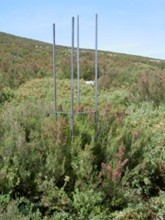
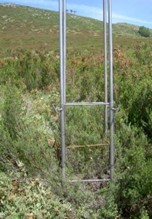
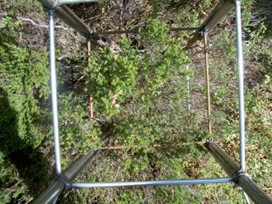
The cube method samples vegetation within 25x25x25 cm cubes, which are mounted or slide along a column up to 2-m high defined by four metallic vertical rods (see photos). Three cube types are defined and are respectively sampled at the top, center and bottom of the height of the shrub; thus a 75-cm height shrub will be sub-divided exactly in three cubes. Adaptation is possible, i.e. larger cubes can be used, especially when sampling taller and wider shrubs, but there is a trade-off in regards to time- and cost-effectiveness.
The “top” cube is always collected from the uppermost 25-cm section of the vertical profile, excluding individual twigs and low-density foliage protruding above high-density biomass. Thus, the work sequence is the following:
- The cubes are inserted in the vegetation and mounted from the bottom to the top, being linked together with clips; a hammer can be used to precisely adjust the overall height such that the top of the column is aligned with the top of the vegetation clump. If a single relatively thick stem/trunk is present, rather than a number of thinner multi-stems, the column should be placed such that the stem is excluded from the profile, to not underestimate the typical concentration of fine biomass.
- All vegetation extending beyond the limits of the column is trimmed prior to extracting the individual cubes.
- Vegetation within the “top” cube is cut and bagged and the container is identified by stand name/location, species, plant/clump height, position in the clump (top, center or bottom), and shrub number, i.e. repetition. Field pre-separation of biomass by size class and dead or live condition can shorten the overall duration of the process.
- After the “top” cube is removed, fuel within the “center” cube is extracted. If the shrub is taller than 75 cm, several cubes can represent the “center”. A standard height of sampling is suggested in these cases as the third 25-cm section starting from the ground surface.
- The “bottom” cube is the one immediately above the ground.
- The fuel particles from each cube are separated in the laboratory into dead and live elements, and into size classes (e.g., leaves, twigs 0–2, 2–6, 6–25 and >25 mm).
- Biomass is oven-dried, typically at 65-100ºC during 8-48 hours, depending on condition and size class. Species high in volatile content can be dried at lower temperatures to avoid mass underestimation.
- The dry weight of each class of fuel particles is measured for each cube and multiplied by the mass-to-volume ratio to estimate the volume fraction (packing ratio).
Calculations
For each cube, and using the dry weights (kg) obtained, the following metrics can be calculated, for each category or combination of categories: fuel load (kg m–2) as the mass divided by 0.0625 m2; bulk density (kg m–3) as the mass divided by the cube volume (~0.0115625 m3); packing ratio as bulk density divided by fuel particle density (kg m–3).
Relation with other methods
NA
Illustrations
Application of the cube method to Erica australis shrubs
Data templates
NA
Further information
Cohen, M., Rigolot, E., Etienne, M., 2002. Modelling fuel distribution with cellular-automata for fuel-break assessment. Forest fire research and wildland fire safety. In: Proceedings of IV International Conference on Forest Fire Research 2002, Wildland Fire Safety Summit, Luso, Coimbra, Portugal, 18–23 November 2002. Millpress Science Publishers, Rotterdam, Netherlands.
Mårell, A., Abdelmoula, K., Allgöwer, B., Borgniet, L., Cassagne, N., Curt, T., Ganteaume, A., Ghosn, D., Gitas, I., Jappiot, M., Jimenez, E., Kazakis, G., Koetz, B., Lampin, C., Machrouh, A., Morsdorf, F., Pimont, F., Rigolot, E., Sesbou, A., Vega, J.-A., Wellani, W., 2008. Fuel description: first results. Deliverable D.3.4-3 of the Integrated project “Fire Paradox”, Project no. FP6-018505, European Commission.