Tree fuel characteristics and loads for fire behavior simulation and fire hazard analysis (forest inventory)
Busquets Olivé, E.1,2; Tardós Ascaso P.1; Piqué Nicolau, M.1,3
1Forest Science and Technology Centre of Catalonia (CTFC)
2Integrated Vocational Education and Training in Forestry – Agricultural schools – DARPA
3Joint Research Unit CTFC – AGROTECNIO – CERCA, Solsona, Spain
Last updated: 25/09/2026
Recommended citation:
Busquets Olivé, E., Tardós Ascaso P. & Piqué Nicolau, M. 2026. Tree fuel characteristics and loads for fire behavior simulation and fire hazard analysis (forest inventory). In: Pere Casals, Davide Ascoli, Lena Vilà-Vilardell, Imma Oliveras, Madoka Krick (eds.) 2026. Methods handbook for characterizing fire use behavior, assessing fire effects, and monitoring soil and vegetation responses at the stand level. FIRE-ADAPT project (number 101086416), deliverable D1.1
Indicator
Fuel load: Canopy fuel load
Fuel flammability: Fuel structure
Brief introduction
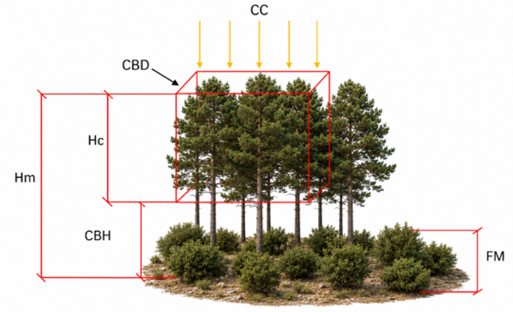
This field datasheet describes how to collect key field variables and subsequently analyze them in the office to characterize the structure and canopy fuel load of forest stands. Canopy fuel characterization is essential for effective wildfire prevention planning and emergency management, as the occurrence of activity crown fire behavior is generally considered to exceed the limits of suppression capacity (Costa et al., 2011). The four main canopy variables are (Figure 1):
- Canopy cover (CC): The proportion of the ground surface that is vertically covered by the projection of tree crowns, including small gaps within individual crowns. Canopy cover is usually expressed as a percentage and influences wind penetration, solar radiation, and the potential for crown fire development (Scott & Reinhardt, 2001).
- Stand Height (Hm): The average height of the dominant and co-dominant trees within a forest stand, measured as the vertical distance from the ground to the top of the tree. This variable provides a representative estimate of stand height and is commonly used to characterize forest structure and support canopy fuel assessments (Avery & Burkhart, 2015).
- Canopy Base Height (CBH): The lowest height above the ground at which there is enough canopy fuel to allow vertical fire propagation from the surface into the tree crowns. Unlike the height to the lowest live branch of an individual tree, canopy base height is a stand-level fuel characteristic that also reflects the influence of understory and ladder fuels (Scott & Reinhardt, 2001).
- Canopy Bulk Density (CBD): The mass of available canopy fuel per volume unit of canopy (kg/m³). It is a stand-level property that describes the amount and spatial concentration of available canopy fuel to sustain active crown fire spread. Higher canopy bulk density generally increases the likelihood of continuous crown fire propagation (Scott & Reinhardt, 2001).
Method specifications
Method type
Soft
Hard
Method timing
Before
fire
During
fire
After fire
(short-term)
After fire
(mid-term)
After fire
(long-term)
Field skills
Low
Medium
Hard
Lab skills
Low
Medium
Hard
Material cost
Low
Medium
Hard
Time cost
Low
Medium
Hard
Calculation expertise
Low
Medium
Hard
Equipment
Hypsometer (Vertex highly recommended)
Reference chart of canopy cover or Spherical Densiometer
Diametric tape
Experimental design
Forest inventory should be based on a network of sample plots distributed across the study area. The number, density, and spatial arrangement of the plots should be adapted to the characteristics of the forest, considering the variability in stand structure and forest types to ensure representative sampling. For a detailed description of the sampling strategy and plot allocation criteria, see Beltran et al. (2023).
Methodology
The methodology presented below is based on data collected from standard forest inventory plots. While canopy fuel variables can also be estimated using rapid field assessments or expert judgement, deriving these variables from forest inventory measurements is recommended because it provides greater accuracy, consistency, and reliability in characterizing forest structure and canopy fuels. Under normal field conditions, experienced practitioners require approximately 30 minutes per inventory plot to complete the measurements.
It is also essential to consider the forest type and the timing of the field inventory. In deciduous or mixed stands containing deciduous species, canopy variables should be assessed only when deciduous trees have reached full leaf development (typically from late spring through summer). Measurements taken before leaf expansion or after leaf fall will underestimate the actual canopy variables. In contrast, this seasonal limitation does not apply to evergreen stands, allowing greater flexibility when planning field inventory campaigns.
For this reason, inventories in deciduous and mixed forests should be scheduled during the fully leafed growing season whenever canopy variables are one of the variables to be measured.
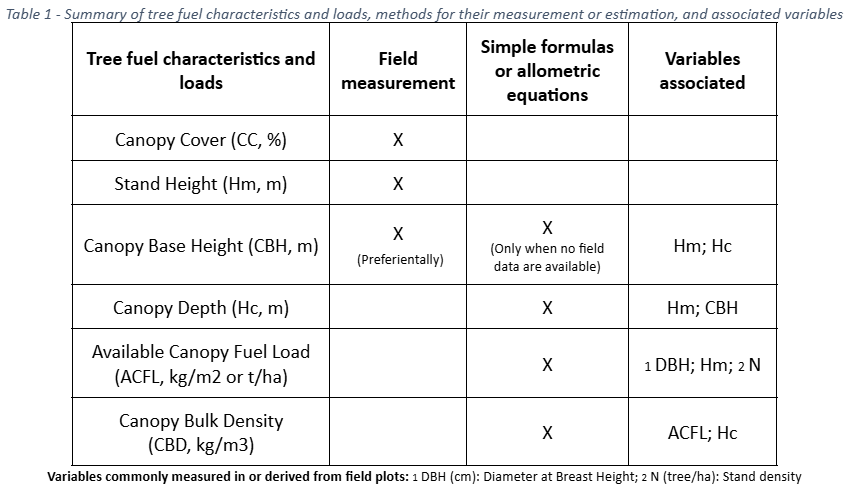
1. Canopy cover (CC, %)
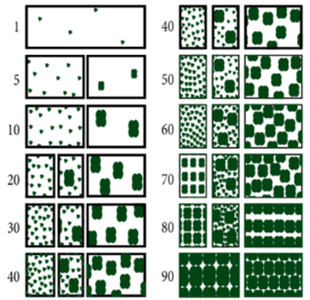
Three alternative methods for estimating Canopy Cover are presented below, ordered from highest to lowest according to the level of fieldwork expertise required. It is recommended that the first method presented below always be used as the primary method. To accurately estimate canopy cover, it is important to survey the entire inventory plot in order to better assess the vertical projection of tree crowns. Estimating canopy cover from a single observation point, such as the center of the plot, may lead to an assessment of canopy closure rather than canopy cover (Figure 2). When canopy cover is estimated visually, it is strongly recommended that field inventories be conducted by at least two observers. Independent assessments and discussion between observers help reduce subjectivity and improve the consistency and reliability of canopy cover estimates while remaining within the limits inherent to visual estimation. For less experienced practitioners, reference charts are available to improve the accuracy of canopy cover estimates (Figure 3).
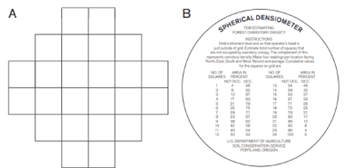
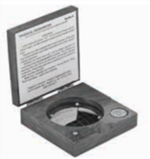
A commonly used instrument for estimating canopy cover, particularly by less experienced observers, is the spherical densiometer (Lemmon, 1956), as it provides a rapid and seemingly objective field assessment (Figure 4). However, the original spherical densiometer employs a convex mirror with a wide field of view (approximately 60°), meaning that it does not strictly measure canopy cover but rather canopy closure (Figure 2). The wide viewing angle causes tree crowns to appear displaced towards the center of the observation, generally resulting in an overestimation of canopy cover (Korhonen et al., 2006). To reduce this bias, Korhonen et al. (2006) modified the spherical densiometer by considering only the four central grid squares of the mirror, thereby reducing the field of view to approximately 20°. Nevertheless, the method still showed relatively high variability (standard deviation of approximately 10%). In addition, its accuracy decreased in young stands and forests with tree heights below 5 m, where the reduced canopy height made reliable observations more difficult (Korhonen et al., 2006).
2. Stand height (Hm, m)
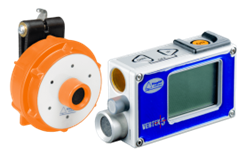
The height of the five trees closest to the center of the plot shall be measured, excluding suppressed and dead or broken trees. The use of a Vertex hypsometer (Figure 5) is recommended to ensure accurate and consistent tree height measurements. Beyond height assessment, the Vertex is also a valuable tool for efficiently establishing inventory plots, as it enables rapid and precise layout of plot centers, radius, and boundaries, thereby improving both field efficiency and measurement accuracy.
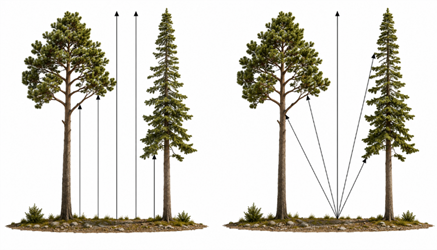
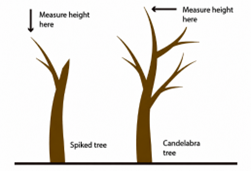
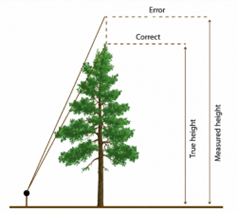
Total tree height is defined as the vertical distance between the horizontal ground plane at the base of the tree and the horizontal plane passing through the highest point of the tree (Figure 6). Stem length should only be measured along the stem axis when trees are markedly curved or leaning more than 50° from the vertical. Tree height shall be measured using the hypsometer function of the Vertex instrument. The observer should always stand at the same elevation as, or above, the base of the tree, and never below it.
A common measurement error that should be avoided is aiming at the apparent top of the tree instead of the true highest point of the crown. This mistake is particularly frequent in umbrella-shaped crowns, where the line of sight must pass through part of the crown to correctly identify the actual tree apex (Figure 7).
3. Canopy base height (CBH, m)
Canopy base height (CBH, Figure 1) is measured on the same five trees previously selected. It is defined as the height above ground at which the continuous live crown begins, rather than the height of the first live branch. An isolated live branch should not be considered the start of the crown. This should be the primary method for estimating CBH.
If field crews forget to record this variable, or if historical inventory data are being used where canopy base height (CBH) was not included in the measurement protocol, species-specific allometric equations can be used to estimate canopy depth (Hc, Figure 1). Krsnik et al. (2020) provide equations for estimating mean canopy depth for the main tree species of Catalonia (Appendix A, Table A1). Once canopy depth (Hc) has been estimated, canopy base height (CBH) can be calculated as:
𝑪𝑩𝑯=𝑯𝒎−𝑯𝒄
These allometric equations were developed using data from the Fourth Spanish National Forest Inventory (IFN4), in which canopy dimensions were routinely measured. Consequently, they provide a robust alternative when direct CBH measurements are unavailable. If this protocol is applied in other regions, users are encouraged to develop region-specific allometric equations using data from their corresponding National Forest Inventory, provided that canopy dimensions have been recorded.
4. Canopy bulk density (CBD, kg/m3)
The estimation of Canopy Bulk Density (CBD, Figure 1) involves two preliminary calculations: Available Canopy Fuel Load (ACFL) and Mean canopy depth (Hc). Accordingly, all trees within the inventory plot must be identified to species level, their diameter at breast height (DBH, cm) measured, and the total height (Hm) of the five trees nearest to the plot center recorded. Unlike Canopy Bulk Density (CBD), which describes the concentration of canopy fuel within the canopy volume (kg/m3), Available Canopy Fuel Load (ACFL) represents the total mass of combustible canopy fuel per unit ground area (kg/m2).
4.1. Calculation of the ACFL:
Available Canopy Fuel Load (ACFL) is the amount of fuel canopy biomass available for consumption during a crown fire, expressed as dry mass per unit ground area (kg/m2). It typically includes foliage and fine live branches (Ø ≤ 6mm) capable of sustaining crown fire spread while excluding large branches and stem wood (Scott & Reinhardt, 2001).
The following sections describe two alternative methods for estimating Available Canopy Fuel Load (ACFL). Each approach has specific advantages and limitations, which are discussed in detail below. Although the methodologies differ, both are based on species-specific individual-tree allometric equations. Therefore, tree-level biomass estimates must be upscaled using the inventory plot tree density to obtain stand-level Available Canopy Fuel Load (kg/m²).
ALTERNATIVE A: Ruiz-Peinado et al. (2011, 2012) allometries
Two benchmark publications by Ruiz-Peinado and co-authors provide species-specific allometric equations for estimating the biomass of different tree components for the main hardwood and softwood species in Spain. These models are widely used for biomass and carbon stock estimation and were developed using data from the Spanish National Forest Inventory. The references and the corresponding tables containing the recommended equations for estimating canopy fuel load are listed below.
- Softwood species (Table 3 of Ruiz-Peinado et al., 2011): Wb2+n: Biomass weight of thin branch fraction (diameter smaller than 2 cm) with needles (kg).
- Hardwood species (Table 2 of Ruiz-Peinado et al., 2012): Wb2+l: Biomass weight of thin branches fraction (diameter smaller than 2 cm) with leaves (kg).
The predictor variables used in these allometric equations are diameter at breast height (DBH) and total tree height (Hm). In the proposed inventory protocol, DBH is measured for all trees within the plot, whereas Hm is recorded only for the five trees closest to the plot centre. Therefore, when a sufficiently large network of inventory plots is available, it is recommended to develop a local height–diameter model relating DBH to Hm. This allows tree height to be estimated for all trees within the plot and enables the Ruiz-Peinado allometric equations to be applied at the individual-tree level across the entire plot, thereby providing a more accurate estimate of canopy fuel load.
When insufficient data are available to develop local height–diameter allometric models, published equations from the scientific literature can be used instead. In many countries or regions, such equations are available through National Forest Inventory (NFI) publications. As a last alternative, AllometrApp (developed by CREAF) provides a comprehensive collection of species-specific allometric equations for estimating a wide range of individual tree attributes, including tree height from diameter at breast height (DBH). These equations can be used to estimate Hm for all trees within the inventory plot before applying the Ruiz-Peinado biomass equations.
IMPORTANT METHODOLOGICAL CONSIDERATION. The biomass fractions estimated using the Ruiz-Peinado allometric equations include all foliage together with live branches up to 2 cm in diameter. However, according to the canopy fuel definition proposed by Scott and Reinhardt (2001), Available Canopy Fuel Load (ACFL) should only include foliage and the finest live branches (diameter < 6 mm), which represent the fraction of canopy fuel available to sustain crown fire propagation. Consequently, direct application of the Ruiz-Peinado equations would lead to an overestimation of ACFL and, therefore, of Canopy Bulk Density (CBD).
According to Busquets et al. (2025) and based on expert judgement together with calibration against independent reference estimates, a reduction factor of one-third (1/3) has been adopted to better approximate the biomass of foliage and fine live branches (< 6 mm in diameter). Although this correction is empirical and should not be considered universally applicable, it provides estimates that are more consistent with the canopy fuel definition of Scott and Reinhardt (2001) and has shown good agreement with available reference values.
Until species-specific allometric equations are developed specifically to estimate canopy fuel (i.e., foliage plus live branches < 6 mm in diameter), the application of this reduction factor is recommended when using the Ruiz-Peinado equations for estimating Available Canopy Fuel Load (ACFL). Future studies should focus on developing dedicated allometric models that directly quantify the canopy fuel fraction relevant to crown fire behaviour.
ALTERNATIVE B: Foliar Biomass allometries
For Catalonia, foliar biomass can also be estimated using species-specific allometric equations developed within the Ecological and Forest Inventory of Catalonia (Inventari Ecològic i Forestal de Catalunya, IEFC) by CREAF (Burriel et al., 2004). These equations are available through AllometrApp, a tool that compiles species-specific allometric models for estimating a wide range of individual tree attributes. Within AllometrApp, foliar biomass is represented by the variable Leaf Biomass (LB), which is estimated using diameter at breast height (DBH) as the predictor variable.
IMPORTANT METHODOLOGICAL CONSIDERATION. This approach provides a simple and practical alternative for estimating Available Canopy Fuel Load (ACFL), as it does not require estimating the height of every tree within the inventory plot. However, because it only estimates foliar biomass and does not account for the fine live branches (< 6 mm in diameter) included in the canopy fuel definition of Scott and Reinhardt (2001), it is likely to underestimate ACFL and, consequently, Canopy Bulk Density (CBD).
4.2. Calculation of mean canopy depth (Hc)
Since canopy depth is considered a stand-level attribute, it can be estimated directly from the five trees used to measure tree height and canopy base height. For each tree, canopy depth is calculated as the difference between total tree height (Hm) and canopy base height (CBH). The mean canopy depth (Hc) for the inventory plot is then obtained by averaging the canopy depth values of the five (Hm) sampled trees in the plot:
𝑯𝒄=𝑯𝒎−𝑪𝑩𝑯
If canopy base height (CBH) measurements are unavailable (e.g., because they were not included in the original inventory protocol), species-specific allometric equations can be used to estimate mean canopy depth. Krsnik et al. (2020) provide equations for estimating mean canopy depth for the main tree species of Catalonia (Appendix A, Table A1).
Once ACFL and Hc have been estimated, Canopy Bulk Density is calculated as the ratio of available canopy fuel load to mean canopy depth:
𝑪𝑩𝑫=𝑨𝑪𝑭𝑳/𝑯𝒄
Relation with other methods
Other similar methods are the ones developed by Krsnik et al. (2020).
Illustrations
Data templates
NA
Further information
Avery, T. E., & Burkhart, H. E. (2015). Forest Measurements (6th ed.). Waveland Press.
Beltrán, M., Busquets, E., Piqué, M., Domènech, M., Travesset, O. (coord.) 2023. 1r Inventari Nacional Forestal (INF1) del Principat d’Andorra. Metodologia d’establiment i seguiment de la xarxa de parcel·les permanents. Centre de Ciència i Tecnologia Forestal de Catalunya i Andorra Recerca + Innovació. https://doi.org/10.5281/zenodo.11175092s
Burriel, J. A., Gracia, C., Ibàñez, J. J., Mata, T., & Vayreda, J. (2004). Inventari Ecològic i Forestal de Catalunya. Mètodes. CREAF.
Busquets, E.; Valor, T.; Tardos, P.; Beltran, M.; Casals, P.; Larrañaga, A.; Pique, M. (2025). Parametrización de alternativas de gestión para la prevención de incendios y simulación del comportamiento potencial del fuego. Conference: 9º Congreso Forestal Español At: Gijón
Costa Alcubierre, P., Larrañaga Otxoa de Egileor, A., Miralles Bover, M., Daniel Kraus, P., & Castellnou Ribau, M. (2011). La Prevenció dels Grans Incendis Forestals adaptada a l’Incendi Tipus (2011).
Korhonen, L., Korhonen, K. T., Rautiainen, M., & Stenberg, P. (2006). Estimation of forest canopy cover: a comparison of field measurement techniques.
Krsnik, G., Busquets Olivé, E., Pique Nicolau, M., Larrañaga, A., Cardil, A., García-Gonzalo, J., & González Olabarría, J. R. (2020). Regional level data server for fire hazard evaluation and fuel treatments planning. Remote Sensing, 12(24), 4124.
Lemmon, P.E. (1956). A spherical densiometer for estimating forest overstory density. Forest Science 2: 314–320
Farriol, R. (2014). Manual d’estimació pericial en el treball de camp. Manual de suport. Centre de la Propietat Forestal. Generalitat de Catalunya. Departament d’Agricultura, Ramaderia, Pesca, Alimentació i Medi Natural
Ruiz-Peinado, R., del Río, M., & Montero, G. (2011). New models for estimating the carbon sink capacity of Spanish softwood species. Forest Systems, 20(1), 176–188.
Ruiz-Peinado, R., Montero, G., & del Río, M. (2012). Biomass models to estimate carbon stocks for hardwood tree species. Forest Systems, 21(1), 42–52.
Scott, J. H., & Reinhardt, E. D. (2001). Assessing crown fire potential by linking models of surface and crown fire behavior. USDA Forest Service, Rocky Mountain Research Station, Research Paper RMRS-RP-29.