Skip to content

Surface fireline intensity calculated from flame length and depth

Ascoli, D.1

1DISAFA, University of Torino

Last updated: 28/09/2026

Recommended citation:

Ascoli, D. 2026. Surface fireline intensity calculated from flame length and depth. In: Pere Casals, Davide Ascoli, Lena Vilà-Vilardell, Imma Oliveras, Madoka Krick (eds.) 2026. Methods handbook for characterizing fire use behavior, assessing fire effects, and monitoring soil and vegetation responses at the stand level. FIRE-ADAPT project (number 101086416), deliverable D1.1

Indicator

Fire intensity: Fireline intensity

Brief introduction

Fireline intensity is a key variable in fire behaviour science because it integrates fuel consumption, heat release, and rate of spread into a single measure of fire energy output per unit length of fire front. In experimental burns, it is widely used to interpret fire effects and compare fire behaviour across fuels and environmental conditions. However, direct field measurement of fireline intensity is difficult, as it requires accurate estimates of fuel consumption and spread rate during active fires (Alexander & Cruz 2012).

For this reason, indirect and practical estimation methods are commonly adopted. Flame length provides a useful visual proxy for fireline intensity, as it can be readily estimated in the field or derived from photographic analysis. Empirical relationships allow flame length to be converted into quantitative estimates of fireline intensity. Recent evidence indicates that fireline intensity is also influenced by the depth of the flaming (combustion) zone (Finney & Grumstrup 2023).

In this method, flame length and flame zone depth are measured using graduated rods arranged on a regular grid, and photographs are taken as the flame front reaches each rod, allowing both variables to be used for estimating fireline intensity.
Method specifications

Method type

Soft

Hard

Method timing

Before
fire

During
fire

After fire 
(short-term)

After fire
(mid-term)

After fire
(long-term)

Field skills

Low

Medium

Hard

Lab skills

Low

Medium

Hard

Material cost

Low

Medium

Hard

Time cost

Low

Medium

Hard

Calculation expertise

Low

Medium

Hard

Equipment

  • Marked rods in aluminum 2 m in height

  • Fireproof paint or fireproof adhesive tape

  • Photo or video camera

Experimental design

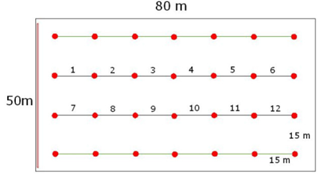
At least 20 marked rods should be positioned in a regular grid (4 × 5) within the prescribed burning site. The distance between poles depends on the size of the experimental area; however, the grid should cover areas that are representative of the site in terms of potential fire behaviour. Each rod must be marked at 0.5 m intervals. Marks can be painted directly on the poles or made using black and red fireproof adhesive tape.

Methodology

  1. Systematically locate the marked rods avoiding non-representative locations (i.e., rock, trees, areas with low probability to burn, sites that are difficult for an observer to see)
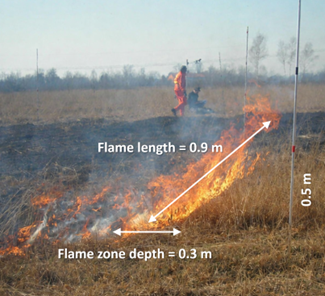
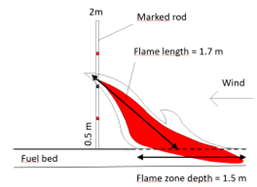
  2. One or two observers make visual estimates in the field during the fire propagation or derive flame length and depth from photographic or video analysis (see image below).

Calculations

To calculate the fireline intensity as a function of flame length and depth use the inverse relationship in Finney & Grumstrup 20231.

\mathrm{I_B}\,(\mathrm{kW}\,\mathrm{m}^{-1}) = 363 \times L^{1.292}  \times D^{0.208}

\begin{array}{l} \textbf{Where:} \\[0.5em] \mathrm{I_B} = \text{Fireline intensity} \\ L = \text{Flame length (m)} \\ D = \text{Flame zone depth (m)} \end{array}

1 Fireline intensity increases nonlinearly with flame length. For a given flame length, wider flame zones (larger D) correspond to higher fireline intensity, reflecting enhanced air entrainment and shorter visible flames for the same energy release. This formulation generalises Byram’s approach (Byram 1959) by explicitly accounting for flame zone geometry, making it more suitable for experimental and modelling applications when 𝐷 D is known or can be approximated.

Relation with other methods

Measurements of Rate of spread can be matched with estimates of Flame length using the Stem char height method.

Illustrations

Grid of marked rods
Estimate of a fireline intensity of 780-790 kW/m
Example of flame length and flame zone depth estimation

Data templates

NA

Further information

Alexander, M. E., & Cruz, M. G. (2012). Interdependencies between flame length and fireline intensity in predicting crown fire initiation and crown scorch height. International journal of wildland fire, 21(2), 95-113.

Byram GM (1959) Combustion of forest fuels. In: Davis KP (ed) Forest fire: control and use. McGraw-Hill, New York, pp 61–89

Finney, M. A., & Grumstrup, T. P. (2023). Effect of flame zone depth on the correlation of flame length with fireline intensity. International journal of wildland fire, 32(7), 1135-1147.