Skip to content

Stem char height

Vilà-Vilardell, L.1; Casals P.1

1Forest Science and Technology Centre of Catalonia (CTFC)

Last updated: 28/09/2026

Recommended citation:

Vilà-Vilardell, L. & Casals, P. 2026. Stem char height. In: Pere Casals, Davide Ascoli, Lena Vilà-Vilardell, Imma Oliveras, Madoka Krick (eds.) 2026. Methods handbook for characterizing fire use behavior, assessing fire effects, and monitoring soil and vegetation responses at the stand level. FIRE-ADAPT project (number 101086416), deliverable D1.1

Indicator

Fire intensity: Flame length

Brief introduction

Stem char height is defined as the maximum vertical height of blackened bark on a tree bole above ground level. Because char height is related to flame height, it can provide an estimate of fire behaviour and serve as a surrogate measure of fireline intensity. It can also be used as an indirect measure of fire severity and, when combined with other variables such as crown scorch, bud kill, and bark thickness, can help predict post-fire tree mortality. Stem char height is usually greatest on the uphill side of the tree or on the side opposite to the direction of maximum spread.

The method consists of measuring the vertical height from ground of the blackened bark on a tree bole.

Method specifications

Method type

Soft

Hard

Method timing

Before
fire

During
fire

After fire 
(short-term)

After fire
(mid-term)

After fire
(long-term)

Field skills

Low

Medium

Hard

Lab skills

Low

Medium

Hard

Material cost

Low

Medium

Hard

Time cost

Low

Medium

Hard

Calculation expertise

Low

Medium

Hard
Equipment

  • Measuring tape (1 mm accuracy)

  • Diameter tape (1 mm accuracy)

  • Spray

Experimental design

The experimental design will change depending on the objective of the study. If the objective is to measure the average stem char height in the burned area, select at least 15 trees ensuring that their diameter at breast height (DBH) is representative of the average DBH of the study site. If the study has a different objective, adapt the sampling design and methodology accordingly.

Methodology

  1. Select the trees to be measured and marking them using a spray at DBH.
  2. Measure the char height vertically from the ground using a tape. Record the maximum (usually on the uphill side in sloping terrain or on the leeward side in flat areas) and the minimum char height around the tree bole.
  3. Measure the DBH using a diameter tape and recording the tree species.

Calculations

\mathrm{SCH}_{\mathrm{max}}\,(\mathrm{m}) = \frac{\sum_{i=1}^{n} Hmax_i}{n}

\begin{array}{l} \textbf{Where:} \\[0.5em] \mathrm{SCH}_{\mathrm{max}} = \text{Stem char height} \\ Hmax_i = \text{Maximum height measured at tree i} \\ n = \text{Number of trees measured} \end{array}
\mathrm{SCH}_{\mathrm{min}}\,(\mathrm{m}) = \frac{\sum_{i=1}^{n} Hmin_i}{n}
\begin{array}{l} \textbf{Where:} \\[0.5em] \mathrm{SCH}_{\mathrm{min}} = \text{Minimum stem char height} \\ Hmin_i = \text{Minimum height measured at tree i} \\ n = \text{Number of trees measured} \end{array}

Relation with other methods

Char height is usually assessed in combination with other fire behaviour or fire severity indicators such as Crown scorch and bud kill, Cambium injury, Tree mortality, and Surface fireline intensity.

Illustrations

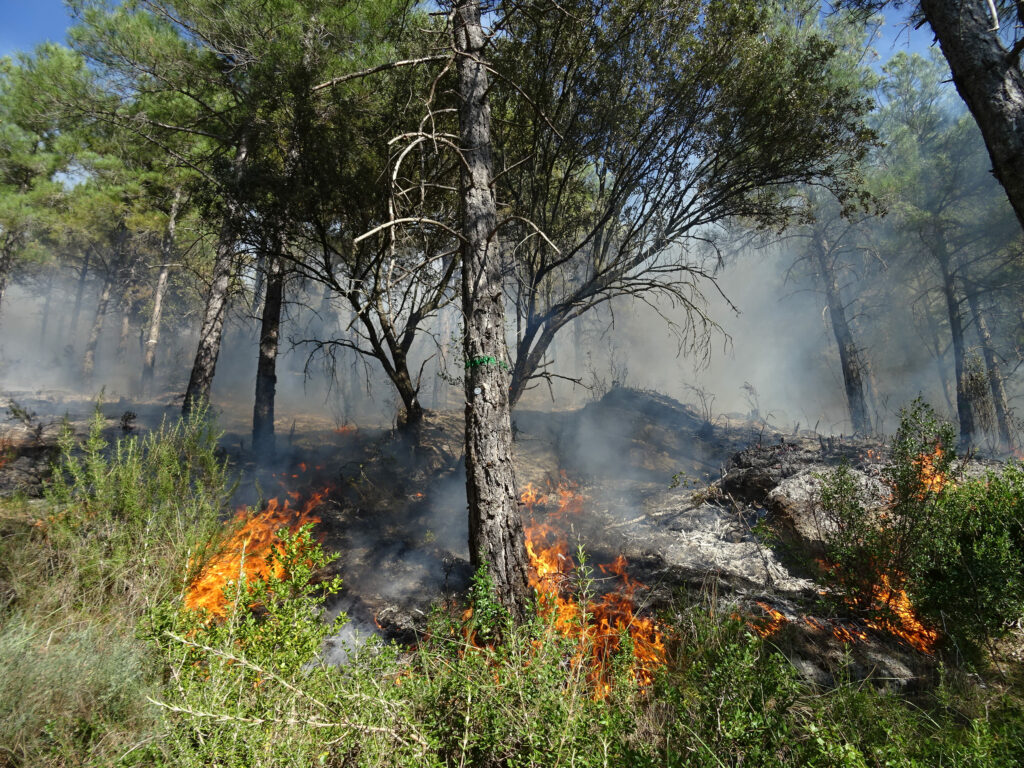
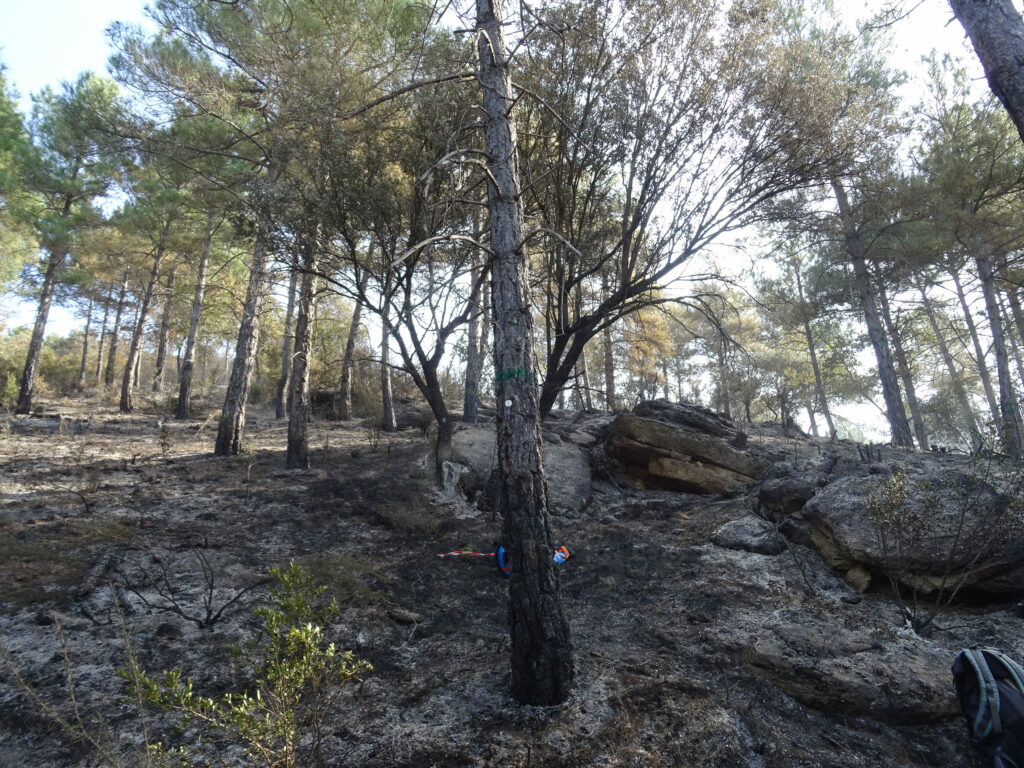
Stem char height
The same pine during a prescribed fire

Data templates

NA

Further information

Hood, S. M., Varner, J. M., Van Mantgem, P., & Cansler, C. A. (2018). Fire and tree death: understanding and improving modeling of fire-induced tree mortality. Environmental Research Letters, 13(11), 113004.

http://www.firewords.net/definitions/char_height.htm

http://www.firewords.net/definitions/bark_char.htm