Fireline intensity is a key variable in fire behaviour science because it integrates fuel consumption, heat release, and rate of spread into a single measure of fire energy output per unit length of fire front. In experimental burns, it is widely used to interpret fire effects and compare fire behaviour across fuels and environmental conditions. However, direct field measurement of fireline intensity is difficult, as it requires accurate estimates of fuel consumption and spread rate during active fires (Alexander & Cruz 2012).
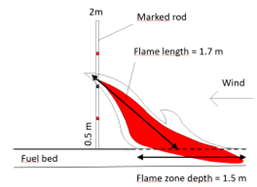
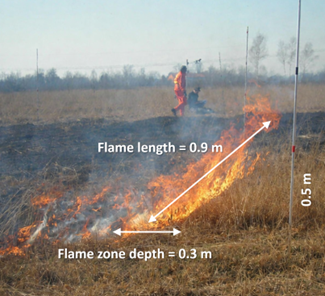
For this reason, indirect and practical estimation methods are commonly adopted. Flame length provides a useful visual proxy for fireline intensity, as it can be readily estimated in the field or derived from photographic analysis. Empirical relationships allow flame length to be converted into quantitative estimates of fireline intensity. Recent evidence indicates that fireline intensity is also influenced by the depth of the flaming (combustion) zone (Finney & Grumstrup 2023).
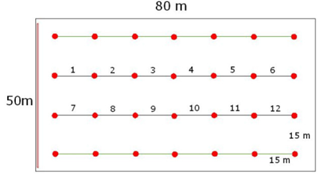
In this method, flame length and flame zone depth are measured using graduated rods arranged on a regular grid, and photographs are taken as the flame front reaches each rod, allowing both variables to be used for estimating fireline intensity.