Skip to content

Pyrometers: heat-sensitive paints for maximum temperature estimation

Valor, T.1

1Department of Agri-Food Engineering and Biotechnology, Universitat Politècnica de Catalunya-BarcelonaTech

Last updated: 28/09/2026

Recommended citation:

Valor, T. 2026. Pyrometers: heat-sensitive paints for maximum temperature estimation. In: Pere Casals, Davide Ascoli, Lena Vilà-Vilardell, Imma Oliveras, Madoka Krick (eds.) 2026. Methods handbook for characterizing fire use behavior, assessing fire effects, and monitoring soil and vegetation responses at the stand level. FIRE-ADAPT project (number 101086416), deliverable D1.1

Indicator

Fire intensity: Fire temperature

Brief introduction

The method uses a series of heat-sensitive paints that change color at specific temperatures, recording only the maximum temperature reached at a given location, without providing information on the duration of high temperatures. This method can be used to assess either the spatial distribution of maximum temperatures across the burn unit or at specific locations of interest (e.g., individual shrubs, trees, topsoil).

Method specifications

Method type

Soft

Hard

Method timing

Before
fire

During
fire

After fire 
(short-term)

After fire
(mid-term)

After fire
(long-term)

Field skills

Low

Medium

Hard

Lab skills

Low

Medium

Hard

Material cost

Low

Medium

Hard

Time cost

Low

Medium

Hard

Calculation expertise

Low

Medium

Hard
Equipment

  • Mica, aluminum, or copper cards measuring 15 cm × 10 cm with a thickness of 2 mm.

  • Thermocolor paints1 of different temperatures, with the most used in prescribed burning experiments being 79, 121, 163, 232, 302, 454, 593, and 704 °C

1 For instance, Tempilaq G or Tempilstik

Experimental design

To evaluate spatial distribution, divide the burn unit into subplots and distribute thermocolor pyrometers across the area. The number and size of subplots should be adapted to the size and heterogeneity of each burn unit. To measure maximum temperatures at specific locations, place the pyrometers at the base of shrubs or trees, or bury them vertically to record both surface and subsurface temperatures.

Methodology

  1. Obtain mica, aluminum, or copper cards measuring 10 cm wide, 15 cm long, and 2 mm thick.
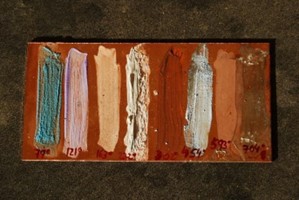
  2. Coat the cards with a series of eight thermocolor paints that change colour at specific temperatures: 79, 121, 163, 232, 302, 454, 593, and 704 °C.
  3. Place the cards at the desired locations:
    • Within subplots.
    • At the stem base of shrubs or trees.
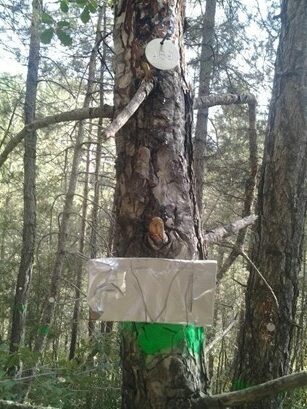
    • At a specific height on the stem, securing them with wire.
    • Buried halfway in the soil, marking the substrate level by cutting a notch on each side of the card.
  4. Before burning, assign a label to each location of interest (e.g., tree, shrub, or subplot).
  5. After the burn, label each card with the same location number assigned before burning.
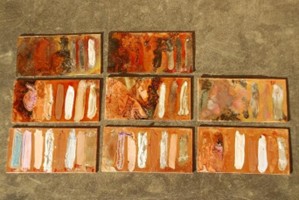
  6. Determine the highest temperature experienced by examining the last paint that changed the color on the card.

Relation with other methods

It can be combined with Ashes color to estimate the intensity of the fire.

Illustrations

Thermocolor pyrometers after the burn, showing the temperature threshold reached based on the last paint that changed colour
Thermocolor pyrometer prepared with heat-sensitive paints (from 79ºC to 704ºC) to for estimating maximum fire temperature
Thermocolor pyrometer installed at a specific height on a tree stem and secured with wire

Data templates

NA

Further information

Hobbs, R. J., Currall, J. E. P., & Gimingham, C. H. (1984). The Use of Thermocolor’ Pyrometers in the Study of Heath Fire Behaviour. The Journal of Ecology, 241-250.

Davies, G. M. Fire behaviour and impact on heather moorland. [PhD Tesis] (Te University of Edinburgh, Edinburgh, 2005) [Accessed 31/03/25]. Available from: http://www.era.lib.ed.ac.uk/handle/1842/2609